9.10.2013

Working out while on vacation


This is an untimely post for the 99% of you who go on summer vacation during the actual summer. But while I'm at the shore I thought to share my vacation workout secrets.

FYI the east coast is awesome in September, if you can swing it.

Anyway, if you're serious about maintaining strength and awesomeness levels while away, you may want to purchase my new e-book called...

Sandxercise

You use sand for variable resistance on each body part, and it goes something like this:

Paw the sand with your arms, like a digging motion, to hit pecs, lats, and shoulders. Paw the sand with one foot then the other, like a raging bull, to hit hips and hamstrings. Reverse foot paws will isolate the quads.

Don't forget to breathe!

Hit some sand hip abduction and adduction, seated and standing versions, wrist extension and curls, etc, and in 75 minutes you will have sufficiently stimulated each muscle in the body.

Okay while Sandxercise is clearly a (lame) joke and goes against pretty much everything I believe about training, getting some physical activity while on vacation is no joke. Personally, I tolerate and appreciate all the leisure much better when I've pushed myself physically.

But hell, it's vacation. If you have trained consistently throughout most of the year and need a break, take a break. Try something different. Do not lock yourself in to the typical grind that your mind and body are accustomed to.

Unless it's convenient and you want to.

It wouldn't hurt me to just go jog a mile or 5, but I almost always opt for 2 or 3 sprint and/or plyometric sessions to get me by a vacation week. I may or may not do some pull-ups, muscle-ups, and push-ups at the park where my kids play.

Today I sprinted. The time wasn't really planned. I'm not sure when the "workout" began. I was coming off the heels of carrying and pulling kids up and down the boardwalks and beach, then digging (not for core, but to make a hole), and jumping around with the kids in the sand.

The beaches in September are fairly open for sprints. Still, seagulls were unintentionally being shoed. Parents 40 yards away were herding young children, shielding them from the mad man skimming over the sand.

The 11 sprints of approximately 80 yards took a total of 18 minutes, including one time-out for a massive horseshoe crab.

Done. Feeling awesome. Ready to sit around and play and eat!

Tomorrow I will probably bike with the kids. And play in the sand. And haul massive amounts of stuff to the beach only to haul it all back 4 hours later.

The first point is to be active, have fun, and give yourself a break if you need it. Secondly, there's nothing that will help you enjoy the rest and relaxation of vacation like a few doses of discomfort scattered throughout the week.


9.03.2013

Strength Tests - how to know if you're strong


There sat a new test
Much harder that you bought in
As for the unseen

just take care of what you will...                  -Chevelle (Sleep Apnea)


Are you physically strong?

How much force can you generate from dead earth, overcoming gravity's effect on the mass of your body and anything you may want to move? How do you really know if you're strong? The answer is less straightforward than you may think.

There is no single, perfect Gold Standard strength test. So you must define what kind of strength you are looking to measure and how you will be measuring it. I mean, nobody really cares how much you can bicep curl. Many tests that are thought of as measuring strength like running, jumping, throwing, etc, are actually better measures of power. Which leads to point number two.

All strength tests measure more than strength.

Every strength test demands various amounts of flexibility, stability, and coordination. Research has repeatedly shown that a simple test of grip strength correlates very well with other upper body, lower body, and total body tests of strength. My observation from over a decade of working as a physical therapist definitely confirms this. Still, I think it's far more meaningful and interesting to say that "she can squat twice her body weight," or "He can do 20 pull-ups," than it is to simply know grip strength.

Any given strength test poses a different challenge to each person. 

On the surface, you may think that a 250 pound bench press is better than a 150 pound bench press. The one guy successfully lifted more weight so he is indeed stronger in the bench press. But what does that mean? What if I told you that the one pressing 150 pounds only weights150 pounds, 50 pounds less than the other guy? Now who's stronger? Or maybe they weigh approximately the same, but the guy with a 250 pound bench press has arms that are two feet long and a big 55-inch barrel chest, while the other guy is 6' 5", with 45 inch chest and arms almost three feet long? Which one would excel at blocking in a football game? At wresting or rebounding in basketball?

This whole scenario is even more obvious if you take something like a pull up test.

Strength depends on more than big muscles. 

If all else is equal in terms of leverage, motor control, stability, flexibility, and neurological efficiency, a bigger muscle will always exert more force than a smaller muscle. But rarely, if ever, is all else equal. A 35-year old with some degree of normal degenerative "stiffness" in his spine will always be able to dead lift more weight than someone 15 years younger. The younger person requires more stability demand before they can pull the weight off the ground.

Some people have huge muscles simply to help make up for poor alignment or leverage. Have you ever witnessed the huge calves of someone with laxity in their foot and ankles? These people are almost never very fast. Those big muscles are  simply making up the difference for poor stability or leverage.

Strength is context specific. 

In power lifting circles, a "raw" (no belts, wraps, braces, etc) 1.5 X body weight bench press, 2X body weight squat, and 2.5X body weight dead lift are respectable. In most commercial gyms among serious gym rats, these numbers are stellar. In most athletic endeavors and especially in the general population, these numbers are unheard of. In reality, there is strong, and there is strong enough. For athletes interested in sports outside of power lifting and Olympic lifting, I'm most definitely interested in promoting and informing you on how to be strong enough.

Strong enough in the legs and core to run or jump in various athletic pursuits without hurting yourself (minimize the risk of ACL/knee or UCL/elbow rupture). Strong enough to lift a grocery bag or suitcase with good form and without straining something. Strong enough to maintain good congruency between the bones of the shoulder joint when throwing or reaching over head. Strong enough to stand for a while with good posture instead of hanging on the ligaments in your neck and back.

Most people do not possess adequate strength to function well. Honestly, I have to say that even by the lowest standards, most of us are pretty weak. But don't take my word for it. Here are a few of the more simple, not too extreme, ways to see for yourself:

Stability Push Up and Push Up tests:

Deep Squat/Squat tests:

Single leg sit-to-stand test:

Pull Up:

In-line Lunge Test:


- - - - -

8.24.2013

THE key to fitness

Name a physical challenge or goal that you want to achieve. Does it involve speed, strength, skill, or body composition? Lower triglycerides? Shoot 90% from the free-throw line?

Whatever it is, there are many specialists in that particular field offering valuable and poor advice. There are sincere as well as snake-oil entrepreneurs offering worthwhile and asinine products and services.

As one of those people, please allow me to remind you of one thing that may be THE most critical element to achieving your goals. But before we get to that, it's worthwhile to discuss a few honorable and not-so-honorable mentions.

Training equipment is definitely over rated. A motivated person will find a way to get it done. They will either get to what they need or make the best of what's around.

Particular diets and supplements are over rated. I'm not saying that what we eat is unimportant. It's the particulars that are unimportant. Diets work because, in the end, they are restrictive. You are actually paying attention to what you eat, eating more unprocessed foods, and taking in less over all.

If you're trying to get lean, lose weight, or whatnot, find a structured diet plan that you can tolerate, fully commit to it, and muster the courage to stick with it for a while. Nobody said it was supposed to be fun. Then, if your activity level is sufficient, you can go back to a more fun and realistic dietary plan that I call The Not Eating Crap Diet. You know what foods are crap. Don't eat them 90% of the time and you should be okay.

I'm aware that this is an overly simplistic bit of dietary advice. But I do hear about and witness some extreme and even odd behaviors where I say to myself, "I bet that person would be fine if they just made a sincere effort at the basics."

And supplements - even the few supplements that are actually proven to live up to their claims do so by a thread. They add less than 5 percent at most. Read for yourself at Examine.com. I cannot speak highly enough of that site.

Training methods are even over rated to some extent. I do recommend that you find something safe in terms of exercise selection, execution, and rest/recovery. A good training method includes an assessment and establishes rhythm and structure that is compatible with your goals, rather than "mixing it up all the time," which rarely lets you know where you stand. Also, be careful of methods that guarantee that your body will adapt toward two incompatible goals at once. For example, it's not likely that a trained individual can increase their vertical jump 4" and shave a minute off his or her best 5K time.

No matter your particular goals and interests, you can almost always benefit from getting stronger. And that doesn't require fancy tools or complex strategies. And now for what's arguably THE most overlooked and undervalued element of you hitting your goals.

CONSISTENCY.

Consistency is finding a way to reach a steady rhythm of work and recovery, not too much and not too little. Consistency is committing and going at it with gusto but not so much that you burn out or get injured in six weeks. Consistency is showing up and keeping at it when you don't feel like it. Consistency is paying attention, learning from victories and failures, ensuring that in time you are working harder and smarter.

Sure, consistency has its limits. Some still think that drinking Slim fast and setting their sights on running a marathon are great ways to "get back in shape."

At Bonny Lane Club (my basement and yard), 20 Rep Squats are the one thing that best defines what we do. We find a way to get to them week in and week out. We strive to add just a few pounds to the bar each week. It becomes brutal. When we get tired, bored, lazy, or want to switch it up for variety, we'll maybe do a different core exercise. We'll do some dumbbell work outside rather than inside. We'll change the music that blasts while we're under the bar. But the squats stay!

Nobody can sell you consistency. Only you know your life's rhythm. Of course this applies to most aspects of life, so define what is important to you, be consistent, and find a way to enjoy the process. Temper your dietary and activity related goals by maintaining some perspective and gratitude on the plentiful life and times in which we live.


Work smart. Work hard. Consistently.

8.17.2013

Biggest Doers


I imagined a script for a TV show called Biggest Doers. It's not that I think that Biggest Loser is terrible or has it all wrong. There's certainly a lot worse that can be found on prime time TV. But...

Instead of featuring extreme health and fitness makeovers of obese contestant with "outlier" lifestyle habits, body weight, and blood profiles, this show includes more average folk. Participants actually keep the majority of their daily routines and responsibilities while forging the time and effort that it takes to intelligently prepare and train their bodies to ACTUALLY DO SOMETHING awesome.

So many levels of wrong here...
Sure, there can be talk of body composition and appearance, because who doesn't want that? But I'm certain that if you can get your body to move better that usually leads to feeling better which leads to DOING further-faster-stronger-longer. By then, things like appearance, weight, and blood profiles almost always tend to take care of themselves.

And if Jillian Michaels can use a show to market her barking around and crappy personal training programs, then I sure as hell am going to use this to showcase the profession of physical therapy and what an individualized, structured, and progressive training plan looks like.

Instead of the Weekly Weigh-In, imagine the teenager who has to get up in front of tens of thousands of viewers and 20 Rep Squat some miserably high weight that's 5% more than he did last week. With that televised event bearing down upon him and cameras looming as he goes about his week, do you think he will get enough rest, wake up in time for a healthy breakfast, and work hard and smart on his other training days? Do you think he will still be complaining about not being able to put on muscle?

Or what about the soccer mom who thought she needed to lose twenty pounds? She was caught in a cycle of "not being able to lose weight because I can't exercise because it stirs up this plantar fasciitis that kills..." On Weigh In Awesome Day after week one she's able to walk in the morning with a reasonably symmetrical gait pattern. By week 4 she can do a chin-up and stop her knees from buckling inward when she pulls weight off the ground. By week 6 she's back to jogging. There are a few set-back for drama, and because there usually are setbacks. At her week 12 Awesome Day she runs a 5K in under 25 minutes.

The Grandma who wants to hike the Appalachian Trail with her grandchildren? The collegiate pitcher with nagging elbow pain who wants to hit 90 mph with his fast ball? The 37 year old father of five who wants to run a 4.6 second 40-yard dash? Where do they currently stand and what are their barriers? What unique physical, employment, and family limitations do they face? How much time do they really need to commit to training? [Anser - really not too much.] How much do they need to tailor their life choices toward achieving their goals [Anwer - a lot!]

As opposed to seeing people standing there being weighed in their undies, wouldn't it be far more entertaining and inspiring to watch an average Jane or Joe perform some self selected, (relatively!) superhuman feat of strength or endurance that he or she has trained toward? Wouldn't it be interesting to witness the Hollwood quick-edited version of the steps they take along the way? Maybe when all is said and done, some of the younger ones do break out of average Joe/Jane mediocrity and end up going big college or even pro at baseball or biking or Crossfit or what have you.

But make no mistake, the primary target and competition for each contestant is themselves, achieving some physical feat of awesomeness they previously could not do.


8.10.2013

Why Do Plyometrics

A friend presented a question to me last week. And there it was, she said it right to my face.

 "So why do all the plyometric jumping and stuff? What's that good for...?"

Why do plyos? Why. Do. Plyos.

I was startled, frozen for a moment. I've never considered that as an option; that someone who is physically able to do plyos would not do them.

Uh. Let's see. Plyos are fun. And awesome. Enough said? [Walks away.] Well no, not really. So here are a few good reasons why athletes should do plyos.

1. Power

Power = Force X Distance / Time


In everyday life and especially in sports, the name of the game is power. Successful performance almost always depends on the ability to move your body, body segments, competitors, and sports implements quickly, with accuracy, and with good mechanics so as to remain efficient and healthy. Plyos teach your brain how to coordinate multiple body segments in order to generate force quickly.

Going for a jog or doing a bazillion reps (Ala P90 X or Insanity) simply doesn't do this unless you're very untrained. Heavy resistance training is the best way to increase your capacity to generate force and increase the size of your engine. But a proper progression of basic plyometric drills are what allow the brain to transform that force into real life, butt kicking power.

(You can legitimately argue that Olympic Lifts are good and necessary for power development, but see here for why I generally don't use of advise them.)

2. React

Plyos have also been shown to improve something called rate of force development, which is basically how quickly your muscles respond when the brain signals to move. And suddenly you're dunking, spiking, and breaking opponents ankles!

3. Fast Twitch Fiber Training

        - - - - - - - - - - -


[chart from Wikipedia] Type I fibers (red) Type II a fibers (red) Type II x fibers Type II b fibers (white)
Contraction time Slow Moderately Fast Fast Very fast
Size of motor neuron Small Medium Large Very large
Resistance to fatigue High Fairly high Intermediate Low
Activity Used for Aerobic Long-term anaerobic Short-term anaerobic Short-term anaerobic


Power produced Low Medium High Very high
Mitochondrial density Very High High Medium Low


- - - - - - - - - -


No matter the chosen sport or activity, you want to get all that you can out of your body. Even endurance athletes benefit from having trained all of the muscle fibers they are given. Now, the body won't even call the strong, fast twitch fibers into play unless it has to move something very heavy or move very quickly. Plyometrics preferentially target fast twitch fibers; the ones that just don't get used when going for a jog or with 30 minutes on an elliptical trainer.

4. Getting In Shape

Plyos are good for conditioning. Jumping, sprinting, cutting, skipping, striding, and various throws are all some the most metabolically demanding activities that you can dream up. Plyos are no stroll on the recumbent bike. Fifteen or twenty minutes provides a brutal training effect. I've witnessed endurance athletes with beastly cardiovascular systems become quickly gassed with a few circuits of intense plyos. It's a different training stimulus than what they are accustomed to.

Fun

Plyos are not nearly as boring and miserable as long drawn out cardio, especially if you have friends to show boat with. Plus - how you look and feel and what you can do after having trained your body with plyos...

Well there are many ways to do it, but we roll something like this:


 And a word of caution.

Plyos must be handled with care. They can be hard on your feet, knees, and lower back if you're inflexible or weak in the ankles, hips, and core. It's not just the middle aged men and their torn achilles tendons, because even young people will suffer if they do too much too quickly or even the right amounts with poor technique.

Just like anything else, use an intelligent progression to get the ball rolling and build up the intensity of impact as well as the total number of impacts. It's well worth it, unless you really don't care about being awesome ; )

Now go be strong, fast, and look the part. Defy some gravity, would ya!

- - - - - -
 

8.01.2013

dead lifts are for everyone


What? You don't believe in doing dead lifts?


Have you ever had to pick something up off the ground? You leaned over in some fashion, grabbed an item, and managed to generate enough force off the ground such that the mass of that object and your body overcomes gravity?

You, my friend, have definitely done dead lifts. Because everybody dead lifts, sometimes. 

And hopefully you crushed that lift of the pencil or suitcase or toddler because your hips, abdominal, and back muscles were strong and tight, from the small fine-tuning muscles to the large movers. You had the flexibility in your hips to allow smooth decent while you maintained the spine in a neutral position. You reached down in a manner that protects the discs and vertebrae from torsional and shear forces while they are under compressive load.

Oh, but that's right. You don't believe in doing dead lifts to establish or strengthen this pattern.

So instead, when you're called upon to pick things up and put them down in everyday life, you probably collapse in at the knees, round your back, cave at the chest, and resemble a weeping willow. It's funny to me that medical and fitness professionals who think dead lift variations are unfit for any exercise program are apparently fine with this mechanical mess.

The Weepy: rounded thoracic and lumbar spine and knees collapsed toward each other. Makes me sad.

Don't get me wrong, there are alternatives for functional lifting, just no good ones.

One alternative is the "lift with your legs not with your back" Robot Lift. What does that mean, exactly? Keeping the torso strictly vertical? Go ahead and try lifting with your trunk perfectly upright. It's even worse when there's weakness or inadequate range of motion at the lumbar spine, hips, or ankles. The Robot is inefficient. You're simply not going call on The Robot to lift a stick off the ground or lift 300 boxes over an 8-hour work day. The Robot can also be extremely hard on the knees (menisci, anyone) sooner or later.


     The Robot: trunk vertical, hips super low, heels off the ground, crushing the knees.

Maybe you tried The Swan. That works well for light objects in open spaces. But the swan is a weak move that demands a lot of balance. Go ahead and try lifting a wriggly toddler with the Swam, or scooting a couch out of the tight fit in the living room.

                        The Swan: one arm forward and one leg back to counterbalance. 
              Spares the knees and lower back fairly well. Efficient, graceful, and weak.

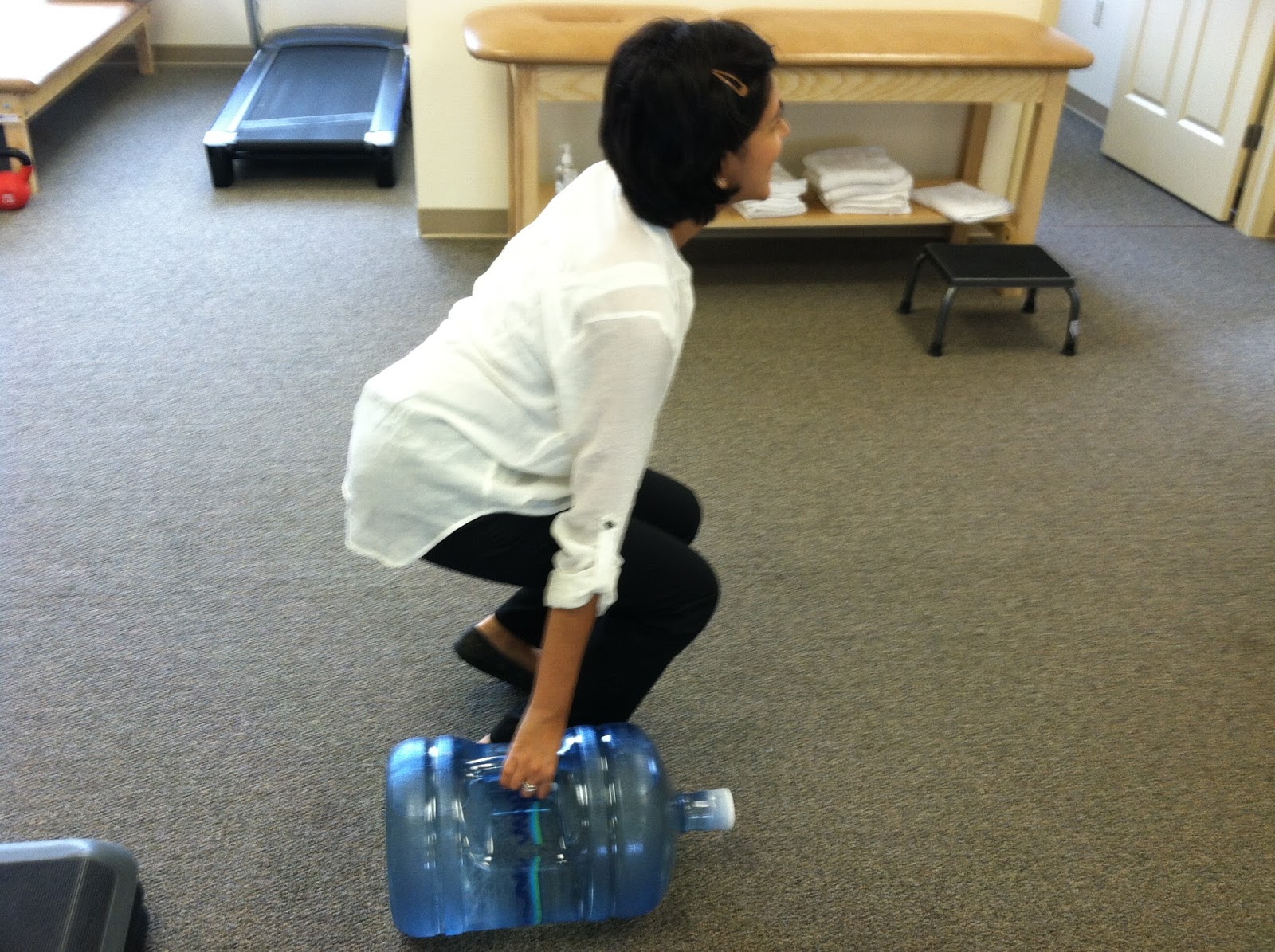
Or, you could trust dead lifts. You could learn how to hinge the hips and knees while tilting the torso forward without slumping. You may never even touch a barbell for conventional dead lifts. Or maybe you will, working up to pulling over double your body weight off the ground with relative ease. Or maybe you'll get to more conventional dead lifts only after improving your strength and mobility with a handful of stretches and dead lift variations.


                                  Dead lift: Hip hinge, neutral spine, no collapse of knees. 


                                                  BAM! [yes - the big water bottle is full]

There's no one formula that fits everyone. But picking things up and putting them down is a part of life. Yes, you will dead lift. So you may as well do it well by incorporating dead lift variations and progressions into your training routine.

 - - - - -


7.10.2013

training setbacks

Last week I planted my hand while playing freeze tag with the kids, failing to notice that my ring finger was stuck in the playground fort. All of me, save that finger, sprang forward in a tag attempt, fracturing my 4th metacarpal. This injury is known as a Boxers Fracture, which sounds a lot better than a Lame Dad Freeze Tag fracture.


I can hardly type with my right hand much less hold anything of substance. There will be no heavy pulls for a while. There goes chin-ups plus 150 pounds extra. There goes the 550 pound dead lift.

 [Boohoo I do remain thankful it's nothing worse.]

For now.

But I will run a little more. I will squat, tow the sled, 20-rep squat, single leg split squat, and, uhm, squat. Maybe I'll spend time in other ventures, like painting the house, reading more to the kids, or napping. And that's plenty.

Resistance!

Even if you truly have the best of intentions and full commitment to your health and performance, set-backs will happen. Life tends to get in the way of any worthwhile and challenging goals we set for ourselves. This is resistance, every ounce as real and heavy as the barbell I'm currently not dead lifting.

Resistance comes from both within and outside of us. It's not often within our control, which can be challenging for athletes and other fitness type folk. Motivation isn't much of an issue for us. But we gnaw on the edges of our God given limits until we meet our goals, lose interest, or injure ourselves. Sometimes we just get our fingers stuck in the playground.

Nonlinear

It's unrealistic to think that you are going to improve on anything and everything each time you do it, just because you're trying hard. Whether running a mile, throwing a baseball, or playing the flute, personal records don't work like that. At least not for long. You will come down with the flu or a cold, strain something, or at least develop plantar fasciitis, lower back, knee, or shoulder problems. You will be busy and stressed and have difficulty finding time for training much less forging new limits.

When that happens, sometimes the absolute best thing we can do is take a week or two off. That's reasonable. You probably need a dose of perspective anyway.

But, we can almost always...

Save up to cash in

Maybe you're not even working directly toward the goal you originally had in mind, but you're working. Growing in some way. Feeding the system. Learning how to adapt. Tolerating discomfort. Improving, hopefully in a weak area.

If you really want to achieve something remarkable, find a way to be proactive and improve in some related way during the set-backs. It's like making deposits into your awesome bucket. And then some day, when you're feeling better, back to consistently walking down the original path, you cash it in. That's how 600 pound dead lifts and 90 mph fast balls and sub-5 minute miles and reverse 2-hand dunks go down.

A friend of mine who loves resistance training was having back pain and was short on time for a while. But he did something, which for him meant some leg press, lunge variations, rehab/mobility work, and 10 minutes of intense bike sprints once per week. Guess what happened when he started to heal? He ran a 5:30 mile, squatted over 230 lbs for 20 reps, and out sprinted everyone with relatively little serious power training!

He stowed away some savings, and then cashed in after training in his "ideal" way for a relatively short while.

And here's me rehabbing a fractured hand, "working the core" until I can pull again:

Single leg split squat 315 lbs X 12 (this is how you work the core!)


When you see someone do something remarkable, know that it's not all what they did right up to that point in time. For heavens sakes, don't you dare write it all off to genetics. Do not underrate what that person did when they were down or how they adapted when life threw them a big or little curve ball.

Everyone has set-backs. Reframe them into a time to reflect and grow.

 - - - - -