5.22.2016

Interview with God


Yesterday I came across this video at The Onion.


The first few seconds of the video were perfect and made me LOL. The smug human with his fancy haircut and suit, is going to make use of his special connection with the Big Man upstairs. He is giving us the privilege of being a spectator as God is put in the dock.

But then I quit laughing. The video brought up a few memories that hang in the back of my mind even now.

The ancient man approached God (or even the gods) as the accused person approaches his judge. For the modern man, the roles are quite reversed. He is the judge: God is in the dock. He is quite a kindly judge; if God should have a reasonable defense for being the god who permits war, poverty, and disease, he is ready to listen to it. The trial may even end in God’s acquittal. But the important thing is that man is on the bench and God is in the dock.” 

C.S. Lewis, God in the Dock: Essays on Theology and Ethics


As a boy with an active imagination, I spent a lot of time in my bed at night wondering about the big questions like what happens when a person dies and what it would be like to meet God. I would literally become dizzy trying to truly comprehend things that I heard in science class or in church, like what an expanding universe or time eternal might mean.

And now, having accrued 40 years of life experience and some knowledge, these things still hurt my head.

I'm not claiming to be an expert.

My credentials include watching what's happening around me for 40 years. That, and I've sat through two Bible studies on heaven and the afterlife. Over the years I have read a few books by Randy Alcorn and nearly everything by CS Lewis, some of it twice. I've read Rob Bell's Love Wins and Francis Chan's response to it. I've read a few New Testament scholars who dissect the Bible like a forensic anthropologist. I've read the atheistic/materialistic perspective and, quite honestly, find that the most terrifying.

It all still hurts my head. And even now I find it difficult to keep in mind that this video is satire.

What The Onion got wrong, I believe, is the type of fear they portray. I think they should have shot for a respectful fear, not wrath and outright fright. I do believe in a judgment of some sort. Jesus spoke a lo about this and indicated that many of the religious insiders will be surprised at how they are judged.

Imagine what it would be like to experience a blinding flash of all of reality, as if seeing through the eyes of God. I think the feeling would be of great love and peace on Gods end, and much regret on ours. But I do find it likely that all we have to say for ourselves may sound something...This is not satire.

"I understand. I'm sorry. I'm sorry. Thank you."


5.21.2016

Everything What's Wrong of My Foot

This caricature of things heard and witnessed in physical therapy was inspired by this. Most of these are not quotes, and no one person said all of this. But, they...were... 

Most physical therapists will get this. Others...maybe not.  

 - - - - - - -

Image result for soak them in ebson salts


The pain is the worst when I walk and it's most severe when I sit for too long.


And I don't want to keep taking Advil to just masquerade the pain.

And the doctor said there is some arthritis in there but he doesn't want to go in before I can't stand it.

And I'm using essential oils and some other nature rubs because that costs less than the gym.

And I didn't have time for my exercises so I laid on the heating pad.

And the doctor said it's the most arthritic joint he's ever seen [Heard approximately once per week].

Well that's hard to do and why are you having me do exercises that I can't do well?

And it just needs cracked and put back in alignment.

And it's just tight in there and needs to be stretched.

Because it sounds like rice crispies when I move it in circles.

And taking them as directed made me constipated so I don't need to sit on the toilet anyway.

And my meridians are blurred through that area, which manifests in sensitivity of the fourth toe.

It was waking me up in the night but now I'm doing better with not sleeping.

And I already had 56 visits at Drayer (physical therapy) and the foot feels about the same.

5.09.2016

An amazing save

He is fouled in the box with less than one minute remaining and the City Islanders down 2 to 3. The crowd of five or six hundred fans (my unofficial estimate) rises to their feet. FNB Stadium and all of City Island falls silent as he places the ball on the mark and lines up for the kick 12-yards out from the goal.

He hesitates, approaches, and unleashes a powerful blast. The ball rockets toward the goalie, over the goal, above eight rows of fans behind the goal, across a section of sidewalk, and finally put to a stop by a large sign hanging over the Socceritaville Bar.

Not even close.

The game winds down in less than a minute. City Islanders lose.

He stands alone then squats down near midfield, facing an empty section of the stadium near the Harrisburg Senator dugout. The opposing goalie gloats with his teammates, mocks a few Harrisburg players and fans, and runs out to mid field. He pats the lone Islander on the back, rubs his shoulder and reaches down to shake hands.

He's still squatting with a painful countenance. Maybe he will collapse and cry. Maybe he will dislocate the gloating goalie's right arm and beat him over the head with it.

He reaches out, shakes the goalies hand.

Fifteen minutes later, a group of young fans collects autographs at the edge of the field. I see the painful look slowly approach the exit. He stops, says "Hello...yes...thank you," while signing a dozen signatures. The painful look returns as he faces the locker room. He begins walking away from the crowd.

My friends son runs him down from behind, holding up a water bottle to be signed. I want to step in.

"Trav, not him! Let him go."

But I was too late

He who missed the penalty kick is a bit startled, pauses to see what is tapping at his elbow. I'm waiting for the snap.

But instead, another save.

"Yes. Of course. You're welcome."

I know nearly nothing about Craig Foster, what kind of son and teammate and player he is, or where his career has been or is headed. I don't know what the May 9th game meant to him or to the City Islanders. But I'm sure that he will be well, wherever life takes him.

And that's what I hope to remember about the game tonight.


But you, be sober-minded in all things, endure hardship, do the work of an evangelist, fulfill your work.   2 Timothy 4:5


5.06.2016

Hats off to the Ground


Sometimes I see the world in GRFs. No, not GIFs, but Ground Reaction Forces.


I see the grocery store floor pushing into pummeled blue flip flops. There is an impulse traveling through the feet, ankles, and up to the knees. They are not going to last.


I see a battle happening between asphalt and rubber as the bus merges off the highway, dozens of lives utterly dependent on nothing less than a perfect tie.


I see the linoleum floor deliver a blow that far exceeds the tensile strength of my coffee cup. This necessitates other GRF as I make my way toward the broom and dustpan.


Image result for foot ground reaction forceBut of course, athletic fields and courts are my favorite places to hunt GRFs. Nearly every feat of grace and power begins and ends with an astronomical GRF, usually through the ball of the foot.
 

Not a GRF, but of a GRF.
The far majority of sports and much of everyday life is about friction and triple extension of the hip, knee, and ankle through the ball of the foot. This moment in time garners little attention compared to the events that take place shortly thereafter. But the place where the ground meets the ball of the foot is where it all begins in a wondrous feat that raises GRFs from dead earth.


That 90 mph fast ball up and in, the earth shaking dunk, the nailbiting triple axl and the sick bicycle kick...all awesome displays of ground reaction force through the forefoot.


What Is the Purpose of the Semicircle in Basketball?

The ground gets so little credit. I mean, go ahead and try timing Usain Bolt in 100 meters on the beach where sand swallows his GRFs. Try having Mark Trumbo go to bat, even in short porch Camden against the worst pitchers, while standing on marbles. Rodeo clowns mocking ferocious snorting bulls in water are not remotely impressive.

You go ahead and try cutting to the hoop on a dusty hardwood floor, hitting the brakes in an ice storm, going for a deadlift PR in soggy grass, getting out of the shower, or any other activity where the GRF suffers a loss to the applied force.

Trouble!


Maybe you want to generate some large GRFs yourself, or you're interested in leaving a trail of lesser GRFs with efficiency over long distances. Then you need to work on generating force in triple extension, under extra loading, over a broad range of motion, and in various directions and speeds. You need to achieve proper joint alignment and core stability in order to fully acquire and direct what the ground will grant you. Get off the fitness contraptions and machines, and spend some time on your feet.

But for now, let's all give a great round of applause to The Ground!
Without dependable, quality, and generous GRF, most activities of daily living are nearly impossible, and all of our hard-earned speed, size, and power only works against us. Life as we know it loses it's marvel.

So next time you see that spectacular cut, leap, dive, strike or throw, take a moment to stare at the ground and appreciate the preceding time and place from whence it came.


What? Is it only me?


4.29.2016

5 Training Considerations for Soccer Players


For the last year, life has been in soccer mode. Three brothers have fell in love with the sport, and suddenly it seems that half of my week is spent at the pitch. I'm not complaining. There is much to be enjoyed and learned.

I have a ways to go in understanding the nuances of strategy and technical skill. But I've trained and rehabbed a fair share of soccer players. I have studied physiology and all-out lived athletics since before I can remember. I know some things about helping athletes to stay healthy and improve performance.

I'm on threshold of soccer culture, devoted, but not yet fully immersed. It's a good perspective from which to pause and make note.

Here are 5 training consideration for soccer players (and their parents).

1. Game Changers are Like Lightening.

In soccer, like many sports, the moves of precision and power change games. The best players are fast on the fly and accelerate quickly in all directions. They create separation from other players, fill gaps, and close angles.

Of course, endurance is also important. Endurance is usually required for the athlete to be in a position to display precision and power. The best players repeatedly put on powerful starts, stops, and runs. The average player covers four to six miles in a 90-minute game. I would argue that sufficient endurance is relatively easy to achieve. And being that the far majority of actual in-match sprints are less than five seconds, athletes should devote more effort to improving peak speed and acceleration. It is my opinion that many high level soccer players are the ones able to maintain powerful speed and quickness despite all the endurance work they are put through.


But how does improvement in speed and quickness occur?

It does not happen through running timed miles, 120s, the beep test, or through cross training death circuits. I understand that these (and similar tests) are a common means for coaches to gauge an athlete's fitness level and separate the devoted, hardworking athletes from those who don't truly want to be there. But...

The effort may be somewhat misplaces. These methods are not the best ways for a given athlete to truly improve their peak speed and multidirectional acceleration.

In soccer, sustaining mediocre speed and acceleration for a full 90-minutes will usually get you beat. I understand the need for a preseason gauge of fitness and self descipline. But as far as physical demands, the bulk of training and some of the fitness tests should reflect the demands of the sport.

Loc walking with 190 lbs. For soccer.

 
2. Strength is important

Prominent sprinting coaches emphasize that while running technique has some role in improved sprinting, the critical element in peak speed and acceleration is being able to apply great amounts of force into the ground. The absolute best way to do this is through properly designed and implemented strength training programs. 
 
[For example: "Speed, as it turns out, may be misunderstood. Running fast has more to do with the force one applies to the ground than how quickly one can move the legs."]


Strength training improves lower extremity power and functional core strength. When this occurs without a drastic change in body mass, this directly translates to improved running economy and endurance. Proper training for soccer should not look like bodybuilding or competitive fitness events. Depending on the needs of an individual athlete, the training can be geared toward increasing strength and size versus power and neurological efficiency.

To say it plainly, some soccer players will stand to benefit from gaining quality size, while others may benefit from priming their nervous system without changes in size.

back glutes
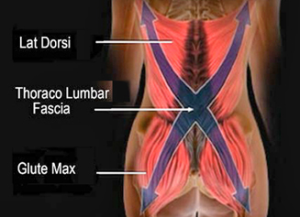
Lats function with glutes. So train those rows, chin-ups, and deadlifts.
Upper body strength is also important. We are not seeking huge upper body swole muscle pump, which easily works against the athletes relative lower body endurance. But powerful shoulders help the athlete doll out and receive contact. A strong and stable core allows the athlete to leverage the hips for safe and efficient total body acceleration and deceleration. Strength training the core well requires more than a few sets of sit-ups and planks.

3. The foundation is important


More than fifteen years as a physical therapist has shown me that the far majority of athletes leave something "on the table" when it comes to performance. They may be strong but lack endurance or flexibility. They may be flexible but display poor control of fast movement. Their "slow footedness" has more to do with hip weakness than anything with the feet. They can static plank all day but the core is clearly weak when challenged to maintain alignment in functional positions. I could go on with examples.


Pepe HATES quality movement ; )
Most athletes will perform better and avoid injury by devoting some time to improving movement quality. They need to learn, in a slow and controlled environment, what proper alignment and movement quality feel like before reaping greater benefit of the more aggressive speed and power training.
 
Without the foundation, playing and training with frequency and intensity is a recipe for injury.

Identifying individual weaknesses and teaching the athlete how to improve the quality of their movement is usually fairly straightforward. But it's not directly related to soccer and does not make for good Instagram photos. And so athletes often altogether miss this step.

4. Recovery is important


It seems that now more then ever, sports take place four seasons per year. There are certainly benefits to this. But what would happen if the athlete spent four months of focused effort on physical preparation, identifying and addressing their weak areas?


But who has time for that? Pre season rightly demands a TON of running. The competitive season games and practices entail a lot of running. And the off season is spent doing intense running, in fear of missing the mark on the beep test, the sub 5-minute mile, and other tests heavily focused on endurance.


Most athletes have no interest in something as unglamorous as recovery. They want to work every day to get ahead. Until the knee tendonitis, the ligament sprain and tears, the shin splints, and the Severs (heel) pain hits them...and fails to get better with rest and ice. 


Appropriate corrective exercise and strength training is a great way to be productive toward soccer performance while providing recovery from the actual impact demands of the sport. Again, I'm referring to well designed and implemented training with focused effort, and NOT epic weight training sessions that leave the athlete exhausted and sore.


5. Rethink "sport-specific"


The traditional way of thinking about strength training for endurance sports is to use high reps and lower resistance. But most soccer players already possess far more than adequate endurance. For these athletes, high repetition, interval weight training is an insufficient stimulus to further improve their on-the-field power or endurance. 
Usually not a great use of time.


Another common training error is to add resistance to the actual movements that occur in the sport, for example, kicking with weights or resistance tubing attached to the leg. But exercise does not need to replicate the exact mechanics of playing the sport. For example, a strong kick and fast sprint requires powerful hip flexors. But doing straight leg raises and kicking drills with tubing or cuff weights strapped to the ankles offers practically no benefit and are great ways to cause injury.


Training that's metabolically and mechanically complimentary to the sport offers the greatest benefit. Using relatively heavy resistance demands the brain to move with greater efficiency. Heavy lifts done well challenge the entire athlete to maintain good posture and stabilize torque throughout multiple body segments.


What qualifies as "heavy resistance" is definitely relative to the individual athlete. Most soccer players would benefit by gradually working their way into powerful, total body movements of low repetition and relatively high resistance.


Then, they may take a solid, powerful machine into the pre-season, condition for power-endurance, go out there and tear it up!


4.17.2016

The Story of Trout Run


I've always been fascinated by freshwater springs. They are real live fairy tales. I stare in wonder at the waters of the deep opening up. Where does all the water come from, and why does it emerge from dead earth exactly in this location? I'm unaware of the extent that this happens throughout the world, for PA is all that I really know.

One spring, in particular, is near and dear to my heart. After emerging approximately one mile upstream, Trout Run flows through my back yard. Our home is okay, but this is definitely why we moved here in 2006. The springs that form Trout Run are consistent. The supply of cold, clean water is almost exactly the same whether we are in the middle of April rains or August droughts. How could this be? 

For fun, I thought to summarize a few nights of my amateur level research.

In the beginning was compression. Over nearly incomprehensible epochs, seashells, microskeletons, and sediments piled up, layer upon layer, with enough crushing force to create enormous limestone flats. This is the DNA of Trout Run, and the shared ancestry of all limestone springs of the Mid Atlantic.

Then came the collision. Tectonic plates bent and heaved, folded themselves as an accordion. And so the land was fashioned into a valley, which happens to be approximately 12-miles wide at this latitude. A hundred thousand years of shifting occurred. Rivers formed and eventually rerouted through the permeable limestone layers. A large underground river came to pass in the deep places of what we now call the Cumberland Valley.

To this day, there is crashing. The river travels through limestone layers, gradually decreasing in width, until running into an impermeable rock wall. The path of least resistance is then up, and water rises to the surface of the earth in "here and there" fashion. Fountains of life are poured forth as from the hands of angels.

Water miraculously ascends all over the valley, especially along the underground ridges of hard rock. To this day, Silver Springs, Trindle Springs, Bermudian Springs, Whiskey Springs, Boiling Springs, Mount Holly Springs, Big Spring and more, all bear witness to this nameless river and unseen rock wall.

For thousands of years, the springs supported a proliferation of wildlife and eventually people. Prehistoric natives would settle around the springs, connecting their establishments by a series of trails that tied the valley to the Susquehanna River.

Prehistoric native Americans gave rise to modern native Americans, and in some instances were replaced by them. Those native Americans were soon replaced by European settlers. Families that landed here gave rise to farms and communities centered on and around the freshwater springs, many of which stand to this day.

In typical white guy fashion, the native American trails were improved (depending on your perspective) and most of them renamed. Lisburn Road, Trindle Road, Old York Road, Carlisle Road, and so forth. These were originally native American trials between various springs which follow an unnamed underground river and rocky geological feature.

I laugh when considering the price of land for sale in proximity to the various roads and traffic patterns. The realtors call them "Prime Location," but probably don't realize this has been the case for many centuries.

Trout Run arises from a series of small springs between old Gettysburg Pike and Williams Grove Road. This year I had the chance to trace this stream to its origins before they are covered with plant overgrowth.

-There is one moderate sized spring near the old Aschomb mansion.

-A little further upstream from there is a large spring surrounded by a well built rock wall immediately next to Lisburn Road.

Trout Run wetlands/preserve

-Approximately 50 feet upstream from that and behind a large red barn is a prominent spring covered by a privately owned and well maintained spring house.

-Approximately one eighth mile upstream from that is the Trout Run nature preserve. Trout Run is actually very small at this point, but in one area does widen into a shallow pond of sorts. Near the side of this pond and middle of the nature preserve is a series of very small springs.


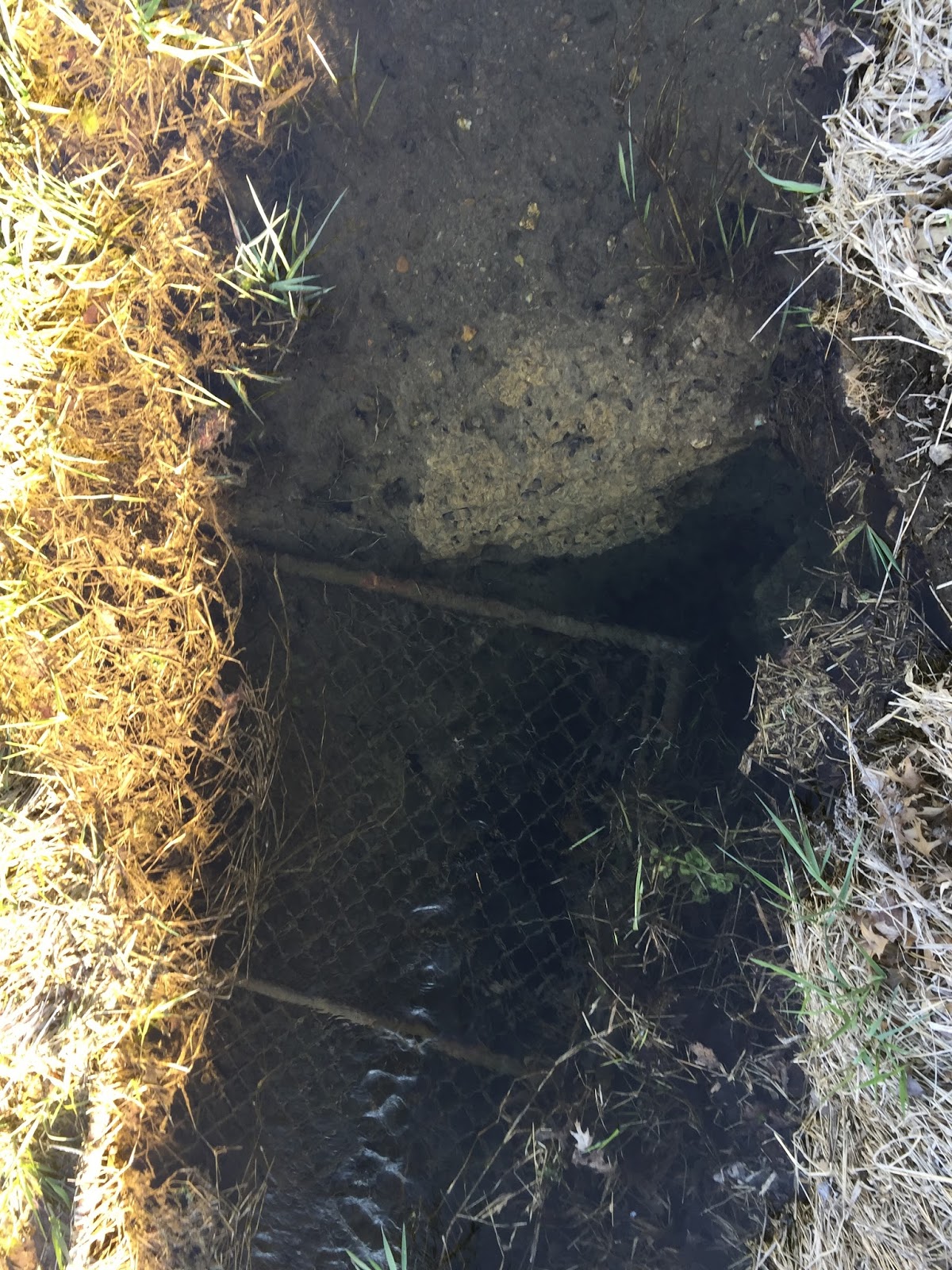
A hole in the clay well is deep and so has a fence across it.
THE birthplace of Trout Run
-Approximately one eighth mile upstream from there is an unremarkable residential backyard with a very deep spring of water popping out from flat ground (image above).

-And finally, twenty or thirty feet upstream from there, at the lowest margin of the land owned by West Shore E-Free Church, directly under a small bridge on the walking path, is a small trickle of water, the VERY beginning of Trout Run.

In it's entirety, Trout Run travels approximately two miles before it feeds into the Yellow Breeches near the athletic fields at Messiah College. The famous Yellow Breeches is simply a gradual surface level reunion of a portion of the large underground river.

But Trout Run is also "the stream," a priceless treasure where we play and swim, catch frogs, water the chickens, and fish for native Brook trout. Trout Run is always a prominent feature in various backyard obstacle races. This is home.

May God help us to share and care for what has been granted us.


4.03.2016

The New Components of Fitness


Some time around 1628, The United States Department of Agriculture created a powerful icon of health and wellness: The Five Components of Physical Fitness.


These were listed as -

Muscular Strength
Muscular Endurance
Cardiovascular Endurance
Flexibility
Body Composition

However, the criteria embodied in this list was not based on sound scientific evidence, and it has not been updated to reflect major advances in our understanding of human health and performance.


In 2017, The US Department of Health and Human Services will officially retire the Five Components in favor of The Four S's of Physical Fitness. The Four S's reflect a simple yet more scientifically accurate criteria. A modern vernacular is used in order to make fitness a more appealing endeavor to the 2/3rds of the American population that is currently sedentary.

The Five Ss of Physical Fitness-

Strength - How much can you dead lift and bench press?
Speed - The ability to turn on the jets and break ankles.
Swolness - Nobody is impressed by a shredded skinny guy.
Showboating - What the individual can actually do with their swolness.

Not helpful to most athletic pursuits other than yoga
Okay, in all seriousness, the original five components could use a major overhaul. For example, everyone knows that being inflexible is a bad thing. But rarely to people appreciate that too much flexibility is also detrimental (particularly to joint health and the individuals ability to be powerful). Being able to sit and bend forward towards your toes says very little in terms of spine health and overall physical function.

Muscular strength and endurance are related.

A stronger muscle will be able to repeat any given submaximal force more times than a weaker muscle. Say that a given task demands 50 units of force. Given the task of repeatedly producing 50 units of force, a muscle that can maximally produce 60 unites will fatigue a lot sooner than a muscle that can maximally produce 100 units. So, in terms of muscle endurance, we need to better define and standardize our terms.

Lastly, current cardiovascular endurance tests highly favor lighter people of well muscled individuals, even though it is certainly possible to be well-muscled and even heavy and have a healthy cardiovascular system. Rather than running or walking, cardiovascular endurance tests should be conducted in a manner where body mass is less of a factor. For example, tests completed on a stationary bike or rowing machine may be a better indication of cardiovascular fitness since these are more independent of body mass.

Being a critic is easy. So here are my recommendation for the components of fitness:

Absolute Strength - One repetition maximum strength tests with free weights are great, but they are contraindicated in some populations. Isometric strength tests are much safer but less clinically valid. How much can you bench press, squat, or deadlift? How much force can you generate?

Relative Strength/Endurance - This would be tested by an individuals ability to repeatedly generate a given force, based off percentage of bodyweight. How many times can you bench press X% of bodyweight? How many full range of motion, strict chin-ups or push ups can you perform? How fast can you run 200 meters?

Absolute Power - This would need to be completed in a more activity- or sport specific manner. With how much force or speed can you hit or throw? How high or far can you throw a standardized medicine ball? How much force can you generate into the ground (would require a basic force platform)?


This bro would probably score very WELL on a Sit&Reach test

Relative Power - Power measures per body weight, activities that involve acceleration of the entire body mass. How high can you jump (vertical jump)? How far can you jump (standing broad jump)? How fast can you run 200 meters?


Controlled mobility - Gone is the Sit & Reach test, as we are less interested in old school passive flexibility. We now want to determine how well a person can maintain good posture and spinal stability while moving through different positions. Can you pass a functional squat test, full lunge and hip hinge, rotational stability test, and can you get up and down off the floor without using your hands?

Cardiovascular Endurance - For how long can you generate 300 watts on a stationary bike? How long does it take you to row 3000 meters?

Body Composition - This should be done away with all together. Measuring body composition is redundant, since many of the fitness components listed above involve strength, power, and controlled mobility relative to body mass. Some lean people have poor strength and cardiovascular health. Some overweight people are very powerful and otherwise fairly healthy. The accuracy of field tests to measure body composition is fairly poor.