- - - - -
I'm no marketing critic, but I think this Planet Fitness ad is hilarious, has retaining power, and gets their core message across. They got it right, the meat-head with an accent wearing ridiculous shorts and sleeve-cut flannel, swigging mystery fluid straight from the gallon jug.
I appreciate that Planet Fitness takes the promise of a nonthreatening exercise environment seriously. Although their "Judgment Free Zone" claim is a bit of a reach for a public gym, I know how often the typical fitness scene can become quirky and downright ugly.
Convenience is not the only reason why I've been training at home for the past decade or so. I've seen young and old men having staring contests with their biceps in practically every gym. I've noticed girls training in butt floss at the Paxton Community Friendship Center, draped over a hamstring curl machine situated in a high traffic area. I witnessed some cyborg inside the Slippery Rock Barbell Club intentionally bloody himself while doing dead lifts, rubbing the knurling of a barbell along his bare shins.
These are the type of things most of us just don't need for our health and wellness.
Planet Fitness caters to all the mostly sane, everyday people who simply want a gym without all the oddball duchebaggish behavior. But the irony in the commercial is that sane, everyday people would benefit most from nothing more than LIFTING THINGS UP AND PUTTING THEM DOWN.
Nothing else is as effective for increasing functional total body strength, balance, coordination, and muscle tone. Not the rows of elliptical machines, the tanning booths, the flat screen TVs, or the newest machines that isolate the triceps and obliques. None of those thing are as time efficient and effective as picking things up and putting them down.
Take lunges. The hip and quadricep (front thigh) muscles must generate force with most of the weight on one leg. Controlling momentum of the body (plus any additional loading like dumbbells) requires the abdominal and back muscles to stabilize the pelvis. The hip adductors (inner thigh muscles) and abductors (outer thigh/butt muscles) balance the leg so that you don’t tip over.
If you're not doing some variations of lunges, rows, dead lifts and chin-ups, pretty much anything that involves you picking things up and putting them down, you probably should be. I make this claim not as a gym-culture blind fitness fanatic, but as a doctor of rehabilitative medicine who has helped hundreds of people to decrease their pain and increase their physical performance.
Lifting things up and putting them down is what real life requires of us. Since we ALL pick things up and put them down, it's often helpful to identify dysfunctional movement patterns and use various modalities, hands-on mobilization, stretching, strengthening, and stabilization exercises to attempt to correct them to the greatest extent possible.
Some of this requires...you guessed it.
Up next is a report on what recently transpired when I tried picking things up and putting them down over at the local Purple.
- - - - -
10.10.2011

10.05.2011
Olympic Lifts
- - - -
Athletes and other serious fitness folks sometimes ask what I think of the Olympic Lifts. Of course the cost/benefit of doing these explosive movements depends on your training status and goals. But we'll move past all the hard evidence and wishy-washy canned answers in order to get down to some nice solid opinion.
In case you're wondering, here's a prime example of an amateur hitting a pretty impressive lift. It displays both the good and the bad of the clean, one of the simplest Olympic Lifts.
Olympic lifts are low-tech, brutally high on effort, effective movements. They are unmatched as total body lifts and will absolutely improve coordination and explosive power. The only problem is that, unless you're competing in the sport of Olympic weightlifting, the Olympic lifts are almost completely unnecessary.
Here are a few reasons why:
The Face Factor
I'm no stranger to missed lifts or strained muscles and joints. But just the thought of building up and pushing my capacities in the Olympic lifts scares me.
Mastering form on these technical lifts takes quite a while. Even then, you can fool around with submaximal resistance to learn technique all you like. That's fine and good for a time-efficient way to burn a lot of energy. But at some point most of us will want to push our limits into new territory, which mandates a lot of yanking and heaving in order to create the high velocity required to hoist heavier and heavier loads. That's when there's so little margin for error.
Contrast this with other big lifts like squats and dead lifts, which employ the use of huge loads and injury potential, but simply don't have the same face-driven-into-the-floor factor. The intention to create an explosive lift is there but because the load is so heavy, the movement is always controlled. You can tell when you're going to lose and/or miss a heavy squat. But Olympic lifts are sometimes...not the greatest for your health and fitness:
There are better ways to gain size.
Getting bigger is about ripping your existing muscle fibers apart and then allowing sufficient time for adequate recovery. The traditional lifts enable heavier loads and more total time under tension, both of which are primary factors in the big breakdown.
There are better ways to gain power.
If you want to get big, strong, and increase the depth of your personal awesomeness bucket, lift heavy things for a lot of reps. Gaining power is all about making your nervous system AMPED. If you want to be able to apply that strength to functional performance, do plyometric activities of maximal effort in various hops, jumps, and medicine ball throws. Plyometrics are a more fun, less risky way to fine-tune the nervous system for total body coordination and explosive power.
Training = Rehab, Rehab = Training
It's truly rare to find a person who does not have some kind of musculoskeletal issue. It may be a slumped thoracic posture, a leg length discrepancy, or poor lumbar stability. It may be inflexible hips, deactivated glutes, or tight ankles. Olympic lifts will absolutely exploit a weak area in a manner that allows little room to identify, much less correct faulty positions and movement patterns. Traditional lifts and their variations usually allow for some degree of focusing attention onto your weakest link.
Gear
The Olympic lifts require bumper plates, loads of space, and a favorable atmosphere. Not a huge deal, but go ahead and try throwing even the 3-pound purple dumbbells up overhead in your basement with light fixtures and 7 foot ceilings. Try dropping even your water bottle at Planet Fitness. I have yet to experimentally identify what sets off the lunk-alert, but I'm guessing that the threshold weight is somewhere right around pink.
And what say you? Have you found the Olympic lifts to be unnecessary and mostly pointless? Or are they an essential key to unlocking your greatest everything?
- - - - -
Athletes and other serious fitness folks sometimes ask what I think of the Olympic Lifts. Of course the cost/benefit of doing these explosive movements depends on your training status and goals. But we'll move past all the hard evidence and wishy-washy canned answers in order to get down to some nice solid opinion.
In case you're wondering, here's a prime example of an amateur hitting a pretty impressive lift. It displays both the good and the bad of the clean, one of the simplest Olympic Lifts.
Olympic lifts are low-tech, brutally high on effort, effective movements. They are unmatched as total body lifts and will absolutely improve coordination and explosive power. The only problem is that, unless you're competing in the sport of Olympic weightlifting, the Olympic lifts are almost completely unnecessary.
Here are a few reasons why:
The Face Factor
I'm no stranger to missed lifts or strained muscles and joints. But just the thought of building up and pushing my capacities in the Olympic lifts scares me.
Mastering form on these technical lifts takes quite a while. Even then, you can fool around with submaximal resistance to learn technique all you like. That's fine and good for a time-efficient way to burn a lot of energy. But at some point most of us will want to push our limits into new territory, which mandates a lot of yanking and heaving in order to create the high velocity required to hoist heavier and heavier loads. That's when there's so little margin for error.
Contrast this with other big lifts like squats and dead lifts, which employ the use of huge loads and injury potential, but simply don't have the same face-driven-into-the-floor factor. The intention to create an explosive lift is there but because the load is so heavy, the movement is always controlled. You can tell when you're going to lose and/or miss a heavy squat. But Olympic lifts are sometimes...not the greatest for your health and fitness:
There are better ways to gain size.
Getting bigger is about ripping your existing muscle fibers apart and then allowing sufficient time for adequate recovery. The traditional lifts enable heavier loads and more total time under tension, both of which are primary factors in the big breakdown.
There are better ways to gain power.
If you want to get big, strong, and increase the depth of your personal awesomeness bucket, lift heavy things for a lot of reps. Gaining power is all about making your nervous system AMPED. If you want to be able to apply that strength to functional performance, do plyometric activities of maximal effort in various hops, jumps, and medicine ball throws. Plyometrics are a more fun, less risky way to fine-tune the nervous system for total body coordination and explosive power.
Training = Rehab, Rehab = Training
It's truly rare to find a person who does not have some kind of musculoskeletal issue. It may be a slumped thoracic posture, a leg length discrepancy, or poor lumbar stability. It may be inflexible hips, deactivated glutes, or tight ankles. Olympic lifts will absolutely exploit a weak area in a manner that allows little room to identify, much less correct faulty positions and movement patterns. Traditional lifts and their variations usually allow for some degree of focusing attention onto your weakest link.
Gear
The Olympic lifts require bumper plates, loads of space, and a favorable atmosphere. Not a huge deal, but go ahead and try throwing even the 3-pound purple dumbbells up overhead in your basement with light fixtures and 7 foot ceilings. Try dropping even your water bottle at Planet Fitness. I have yet to experimentally identify what sets off the lunk-alert, but I'm guessing that the threshold weight is somewhere right around pink.
And what say you? Have you found the Olympic lifts to be unnecessary and mostly pointless? Or are they an essential key to unlocking your greatest everything?
- - - - -
9.20.2011
pushing limits
- - - - -
And there is this knee pain turned chronic.
Nothing lasts, especially the "wow" feats of total body power and risk. Unfortunately, the awesome factor of an activity always seems to be inversely proportional to its longevity. All athletes retire, some more formally than others.
 And yet the theory that a spine or a pair of legs has only a certain number lifts and bends is rubbish. Would we do well do sit around saving our steps, jumps, and lifts? How can we afford to take it light when it is the loading that causes our mind and body to grow, when our entire being becomes more resilient through the magic rhythm of work, rest, and recovery?
And let us not forget the grace of movement, fluid art everywhere, immeasurable.
Ah, to be at peace with limits. To see golf and the elliptical machine and cooking on the grill and cruiser bikes and raking the yard as gifts. That simple and right gratitude pushes my limits.
There is a time for everything, and a season for every activity under the heavens.
Ecclesiastes 3:2
It happened when I gave up on playing collegiate baseball. I swore to avoid typical patterns that yield typical results.
I would not deny my age. I would not act my age. I'd resist the variety of college binges that create atrocious habits and leave you not forever ya, ya, ya, ya, ya-young [Kesha reference]. I wouldn't push through seven years of college so that I could carry a leather briefcase, fancy up the house, buy a luxury car, or invest in stocks for fun.
 |
Tuck jump over 5' 3." is my thing. |
I would always be an athlete, setting goals, thriving on the process of improving my game, strength, speed, or whatever. I would attempt to eat well while not overly burdening anyone, never have to worry about cholesterol or having to diet. I would playfully eye up walls and fences, imagining what strategy I would use to scale or jump that baby outright.
Later I would refuse to talk on the phone or read a book while the kids get to stampede around the yard or playground. I would invite a few like-minded young men, fit and nearly half my age, to train with me. I'd get a dose of youth, intentionally go under the influence of what repels the sneaky stale.
Making good on those promises has been wonderful. Challenges were confronted, risks taken, confidence gained, stories remembered, and friendships forged. We've pulled off feats we would have never imagined.
It would have been hard not to learn a few things along the way. Like how difficult it is to avoid typical patterns, why you don't see many 40 year-olds playing tag with their children much less launching quarter pipes or dead lifting 3 times their body weight.
How do we know when it's time to push limits or to respect them? There's no formula under the sun.
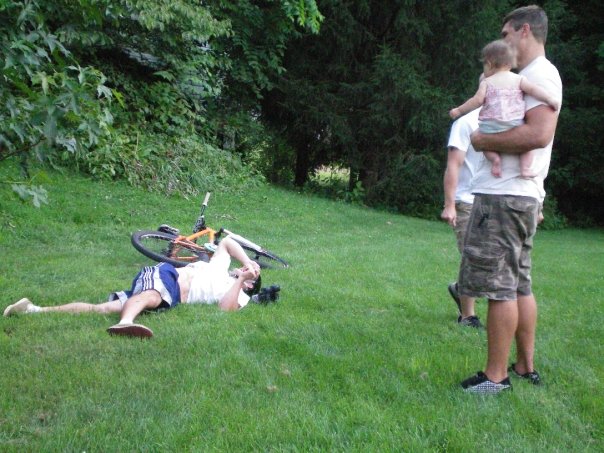
I caught a clue last week when I noticed Tim, Ryan and I leaning on our bikes during what we call Ridin' Time, talking about crab grass. I often perceive the slow closing of that window of time between feeling warmed up and feeling fatigued. I allow walls and fences to mock me. I've grimaced while getting dressed after a day of glorious impact.
It would have been hard not to learn a few things along the way. Like how difficult it is to avoid typical patterns, why you don't see many 40 year-olds playing tag with their children much less launching quarter pipes or dead lifting 3 times their body weight.
How do we know when it's time to push limits or to respect them? There's no formula under the sun.
I caught a clue last week when I noticed Tim, Ryan and I leaning on our bikes during what we call Ridin' Time, talking about crab grass. I often perceive the slow closing of that window of time between feeling warmed up and feeling fatigued. I allow walls and fences to mock me. I've grimaced while getting dressed after a day of glorious impact.
And there is this knee pain turned chronic.
Nothing lasts, especially the "wow" feats of total body power and risk. Unfortunately, the awesome factor of an activity always seems to be inversely proportional to its longevity. All athletes retire, some more formally than others.
To age gracefully is to accept not so graceful movement. We grow wiser. And busy. Stiff, achy, and plain tired. We all slow down, eventually to a stop. Limits always win in the end.
 And yet the theory that a spine or a pair of legs has only a certain number lifts and bends is rubbish. Would we do well do sit around saving our steps, jumps, and lifts? How can we afford to take it light when it is the loading that causes our mind and body to grow, when our entire being becomes more resilient through the magic rhythm of work, rest, and recovery?
And let us not forget the grace of movement, fluid art everywhere, immeasurable.

So I'm hopeful for another decade or so of pushing.
 Will ten years make me content with a shift to maintaining health rather than pushing limits? Will I literally walk away after proving whatever I needed to prove, having had fun, made stories, and dragged a few good friends and family along for the ride? Would I retire before winding up like a some version of the Monty Python Black Night?
 Will ten years make me content with a shift to maintaining health rather than pushing limits? Will I literally walk away after proving whatever I needed to prove, having had fun, made stories, and dragged a few good friends and family along for the ride? Would I retire before winding up like a some version of the Monty Python Black Night?
Probably not. No with mere time. Resiliency has its limits.
Ah, to be at peace with limits. To see golf and the elliptical machine and cooking on the grill and cruiser bikes and raking the yard as gifts. That simple and right gratitude pushes my limits.
Yes, I have some working out to do.
-----
8.25.2011
Abgnostics: the secret secrets of ab secrets
- - - - -
This is for those in pursuit of a solid mid section, wondering what secret knowledge lies hidden behind the ab ads floating all over the place. Or maybe you've considered the numerous benefits of physical training and figure that while you're at it, you may as well do something for your core.
Maybe you could care less, and that's perfectly fine too, so long as you're active and healthy. But I still do receive a lot of questions and see much misinformation pertaining to ab secrets. I've had a fun time doing this before, trying to explain that Abs Are Not The Core, but here's the lean (not skinny) on what all the secrets are trying (or should be trying) to tell you.
 Kung Fu Panda opens the secret scroll.
"It's you. The secret is you."
exercise
It's that simple. You can run, bike, swim, zoomba, scoot, crab walk, shuffleboard, rake, chase puppies, throw children, and so on. You can even do some crunches and leg raises if you like. Whatever you do to huff and puff and burn calories is fine as long as you also do some total body resistance exercise.
You could save a lot of time by simply challenging yourself with progressive resistance training. That would mean fairly high reps and fairly heavy resistance (relative for you) in variations of the big movements like squats and lunges, presses, push-ups and dips, pull-ups and rowing. A few sets of 10 on the seated leg extensions, bicep curls and the shake weight are not going to cut it - your abs. Neither will 1-rep max bench press or 1-rep power cleans.
It's muscle that sticks out - in a good way - in your midsection and other sections. It's the loaded resistance exercises that cause all your trunk muscles to work hard in a functional manner. You don't get that from just running, or swimming, or zoomba, or crab walk, or so on. Plus, muscle is functional, like totally good for doing things, athletics and otherwise; bigger and better, safer and more awesome. But oh, all those injury prevention and functional benefits are mere side effects of being ripped.
Please don't worry about 7 minute abs, 4 minute abs, or any other minute abs. Sure, you should try to include a few "core exercise" variations after or as part of your real training. And yes, Hershel Walker and so-and-so do 15,000 sit-ups each and every night. How dumb! Doing that much of anything does risk developing imbalance and later injury. Far more than that, it's a completely unnecessary waste of time.
On the other hand, gradually, systematically getting to the point where you can dead lift double your body weight for 6 reps and make it look easy...again, the resistance used is relative, but THAT'S what I'm talking about:
Ben C pulling 335 for 6 reps. No wraps or belts. Only
The Hawthorne Effect to prop him up.
eat
This side of the issue is complex because so many factors enter in to what and why we eat. The specifics probably vary and are highly dependent upon your starting point; whether you're already relatively thin or 15 or 100 pounds overweight. Here are a few things to consider no matter where you stand.
No amount of training will make up for a crappy diet. The perfect diet cannot do for your body and mind what intelligent training can.
If you feel like you don't have time to be at the gym 6 days per week and prepare and tolerate broccoli and chicken every day, good because you don't have to. You do not have to eat like a typical bodybuilder. On the other hand, you cannot eat like a "typical" American.
Start with this: give up fried foods, limit sweets to about once per week, and attempt to limit (but don't overly restrict) healthy carbs. Try to find a weekly cycle of a few meals/foods that work well for you and just stick to it, no questions. You WANT to be bored with your food most of the time, but NOT hungry. Nobody said it would always be fun.
These secrets are all general, but I'd be happy to try and address any specific questions or concerns. Just please don't ask about breakthrough supplements or ab machines unless you've tried at least 3 to 6 months of consistent total body resistance training along with boring, non extreme dieting with moderate amounts of mostly non-processed foods ; ) .
- - - - -
This is for those in pursuit of a solid mid section, wondering what secret knowledge lies hidden behind the ab ads floating all over the place. Or maybe you've considered the numerous benefits of physical training and figure that while you're at it, you may as well do something for your core.
Maybe you could care less, and that's perfectly fine too, so long as you're active and healthy. But I still do receive a lot of questions and see much misinformation pertaining to ab secrets. I've had a fun time doing this before, trying to explain that Abs Are Not The Core, but here's the lean (not skinny) on what all the secrets are trying (or should be trying) to tell you.

"It's you. The secret is you."
exercise
It's that simple. You can run, bike, swim, zoomba, scoot, crab walk, shuffleboard, rake, chase puppies, throw children, and so on. You can even do some crunches and leg raises if you like. Whatever you do to huff and puff and burn calories is fine as long as you also do some total body resistance exercise.
You could save a lot of time by simply challenging yourself with progressive resistance training. That would mean fairly high reps and fairly heavy resistance (relative for you) in variations of the big movements like squats and lunges, presses, push-ups and dips, pull-ups and rowing. A few sets of 10 on the seated leg extensions, bicep curls and the shake weight are not going to cut it - your abs. Neither will 1-rep max bench press or 1-rep power cleans.
It's muscle that sticks out - in a good way - in your midsection and other sections. It's the loaded resistance exercises that cause all your trunk muscles to work hard in a functional manner. You don't get that from just running, or swimming, or zoomba, or crab walk, or so on. Plus, muscle is functional, like totally good for doing things, athletics and otherwise; bigger and better, safer and more awesome. But oh, all those injury prevention and functional benefits are mere side effects of being ripped.
Please don't worry about 7 minute abs, 4 minute abs, or any other minute abs. Sure, you should try to include a few "core exercise" variations after or as part of your real training. And yes, Hershel Walker and so-and-so do 15,000 sit-ups each and every night. How dumb! Doing that much of anything does risk developing imbalance and later injury. Far more than that, it's a completely unnecessary waste of time.
On the other hand, gradually, systematically getting to the point where you can dead lift double your body weight for 6 reps and make it look easy...again, the resistance used is relative, but THAT'S what I'm talking about:
Ben C pulling 335 for 6 reps. No wraps or belts. Only
The Hawthorne Effect to prop him up.
eat
This side of the issue is complex because so many factors enter in to what and why we eat. The specifics probably vary and are highly dependent upon your starting point; whether you're already relatively thin or 15 or 100 pounds overweight. Here are a few things to consider no matter where you stand.
No amount of training will make up for a crappy diet. The perfect diet cannot do for your body and mind what intelligent training can.
If you feel like you don't have time to be at the gym 6 days per week and prepare and tolerate broccoli and chicken every day, good because you don't have to. You do not have to eat like a typical bodybuilder. On the other hand, you cannot eat like a "typical" American.
Start with this: give up fried foods, limit sweets to about once per week, and attempt to limit (but don't overly restrict) healthy carbs. Try to find a weekly cycle of a few meals/foods that work well for you and just stick to it, no questions. You WANT to be bored with your food most of the time, but NOT hungry. Nobody said it would always be fun.
These secrets are all general, but I'd be happy to try and address any specific questions or concerns. Just please don't ask about breakthrough supplements or ab machines unless you've tried at least 3 to 6 months of consistent total body resistance training along with boring, non extreme dieting with moderate amounts of mostly non-processed foods ; ) .
- - - - -
8.07.2011
perspective for pushing sports
- - - - -
The boy, twelve years old, appears about fourteen. Loves baseball. Pitched quite well for the team during the playoffs, which also earned him severe shoulder pain.
In the clinic, the boy rolls his head and drops his shoulders when I ask him to complete a second circuit of light scapula stabilization exercise. But he's willing. Dramatically drags himself back toward the weights. It's not that the exercises cause shoulder pain. He's already tired fromswimming poolside horseplay in the heat all day. That, and he's twelve.
His dad, standing by, rolls his head and drops his shoulders.
Dad is right to say that at some point, a young man absolutely must decide for himself if he wants to be the best player he can or just have fun. Either choice is definitely fine, but one requires enormous sacrifice and effort. For most children, 12 years of age is far too soon to face that decision.
How much should a parent push a twelve year old? In most sports like baseball, not much. People of all ages do benefit greatly from some structure and direction. But there's a fine line between inspiring our children to adapt an active lifestyle and dragging him or her half way across the state for their club team. So long that a boy is not sitting around all the time, there's very little room to push at all.
Dad, you have to make him want it.
Which is impossible, of course. I don't think we can make a child passionately driven to high level athletic (or any type of) success any more than we can make him have a favorite food. On the other hand, the formula for burn-out is pretty simple. One great way to make a kid hate pizza is to start him early on pizza and push pizza every day and always talk about pizza.
How much should this father challenge this son to excel in athletics? Who am I to say? It probably depends on both the father and the son. It probably changes from month to month. To the fathers credit, he knows his son well. Clearly loves him. Shares loads of time with him.
Later, over some hands-on shoulder work, I told them that they both love baseball, and I think that's a great start. I reminded the boy that as he gets older and the competition improves, he will probably suffer a few more defeats than he's use to right now. That's when he'll learn some things about what he wants to do with his time.
Either choice really is okay. Lord willing, the boy will find passion for something. He'll need a father who challenges him and supports him. He'll need some time to horseplay in the pool. These are all good things.
- - - - -
The boy, twelve years old, appears about fourteen. Loves baseball. Pitched quite well for the team during the playoffs, which also earned him severe shoulder pain.
In the clinic, the boy rolls his head and drops his shoulders when I ask him to complete a second circuit of light scapula stabilization exercise. But he's willing. Dramatically drags himself back toward the weights. It's not that the exercises cause shoulder pain. He's already tired from
His dad, standing by, rolls his head and drops his shoulders.
"See? He has to understand that if he wants to stay healthy and improve, he's going to have to work at it. I just don't know how much to push a twelve year-old."
Dad is right to say that at some point, a young man absolutely must decide for himself if he wants to be the best player he can or just have fun. Either choice is definitely fine, but one requires enormous sacrifice and effort. For most children, 12 years of age is far too soon to face that decision.
How much should a parent push a twelve year old? In most sports like baseball, not much. People of all ages do benefit greatly from some structure and direction. But there's a fine line between inspiring our children to adapt an active lifestyle and dragging him or her half way across the state for their club team. So long that a boy is not sitting around all the time, there's very little room to push at all.
Dad, you have to make him want it.
 |
| Inspiring my daughter on the joys (and pains) of an active lifestyle |
How much should this father challenge this son to excel in athletics? Who am I to say? It probably depends on both the father and the son. It probably changes from month to month. To the fathers credit, he knows his son well. Clearly loves him. Shares loads of time with him.
Later, over some hands-on shoulder work, I told them that they both love baseball, and I think that's a great start. I reminded the boy that as he gets older and the competition improves, he will probably suffer a few more defeats than he's use to right now. That's when he'll learn some things about what he wants to do with his time.
Either choice really is okay. Lord willing, the boy will find passion for something. He'll need a father who challenges him and supports him. He'll need some time to horseplay in the pool. These are all good things.
- - - - -
7.19.2011
A Season for Disclosure
- - - - -
Patients often ask if my work varies during certain times of the year. The truth is that I've been unable to observe consistent seasonal patterns in the number or type of injuries treated in my office.
January rarely brings an immediate influx of people suffering strains from skiing and snow shoveling. Knee pains born of a New Year's fitness resolution may not reach maturity until July. The spring and fall are quite similar in terms of shoulder pain related to activities like pitching (baseball) and cleaning windows.
These issues are my typical labor and may be rooted in seasonal interests. But many factors obscure the effects of latitude on the yield of injuries, such as individual pain tolerance, patience (or stubbornness), job status, insurance deductibles, and backlogs in the schedules of orthopedic surgeons.
Whatever the season, people with various aches and issues continue to trickle into the office, and I'm thankful for that.
[Wait. Did he just compare pain to a crop and say he's grateful for injuries?]
What I mean is that gratitude through all seasons is critical to my work. This certainly applies to other professions and may seem obvious given a physical therapists calling and place in the entire realm of health care. But in my experience, some models of outpatient rehabilitation serve patients and therapists better than others.
Of course it's rewarding for a physical therapist to help clients regain a portion of their lives, their ability to work, play, or simply care for themselves. But quite honestly, those rewards do have their limits, especially during busy seasons. While all health care providers want to be busy, the art of providing excellent care during busy seasons is not for rookies.
If you or someone you know is in need of outpatient rehabilitation, there are a few things you should know.
It is good when a physical therapists livelihood depends primarily upon the quality of work that they do, and not upon affiliations with health care networks, contractual obligations, or creative lease arrangements.
It is good when the natural checks and balances of free enterprise can quickly dry up the trickle of patients where a therapist fails to deliver outstanding care.
It is good when important business concerns like medical necessity, proficiency, scheduling, and balancing efficiency with quality of care have the chance to take care of themselves instead of being mandated by out of touch administrators.
To list these strengths of small, independent physical therapy practice is not to say that other models cannot provide high quality care. But I've worked in settings where a constant swell of patients presses against you whether or not you take the time to pay attention to the details. I know what it is like to be busy on a beautiful Thursday afternoon when someone needs a lot of reassurance and a little specific guidance beyond the general exercise protocol for their diagnosis.
While there are no substitutes for clinical competency, I’m sure that both patients and providers could stand to benefit from an honest appraisal and disclosure of the season they are in.
- - - - -
Patients often ask if my work varies during certain times of the year. The truth is that I've been unable to observe consistent seasonal patterns in the number or type of injuries treated in my office.
January rarely brings an immediate influx of people suffering strains from skiing and snow shoveling. Knee pains born of a New Year's fitness resolution may not reach maturity until July. The spring and fall are quite similar in terms of shoulder pain related to activities like pitching (baseball) and cleaning windows.
These issues are my typical labor and may be rooted in seasonal interests. But many factors obscure the effects of latitude on the yield of injuries, such as individual pain tolerance, patience (or stubbornness), job status, insurance deductibles, and backlogs in the schedules of orthopedic surgeons.
Whatever the season, people with various aches and issues continue to trickle into the office, and I'm thankful for that.
[Wait. Did he just compare pain to a crop and say he's grateful for injuries?]
What I mean is that gratitude through all seasons is critical to my work. This certainly applies to other professions and may seem obvious given a physical therapists calling and place in the entire realm of health care. But in my experience, some models of outpatient rehabilitation serve patients and therapists better than others.
Of course it's rewarding for a physical therapist to help clients regain a portion of their lives, their ability to work, play, or simply care for themselves. But quite honestly, those rewards do have their limits, especially during busy seasons. While all health care providers want to be busy, the art of providing excellent care during busy seasons is not for rookies.
If you or someone you know is in need of outpatient rehabilitation, there are a few things you should know.
It is good when a physical therapists livelihood depends primarily upon the quality of work that they do, and not upon affiliations with health care networks, contractual obligations, or creative lease arrangements.
It is good when the natural checks and balances of free enterprise can quickly dry up the trickle of patients where a therapist fails to deliver outstanding care.
It is good when important business concerns like medical necessity, proficiency, scheduling, and balancing efficiency with quality of care have the chance to take care of themselves instead of being mandated by out of touch administrators.
To list these strengths of small, independent physical therapy practice is not to say that other models cannot provide high quality care. But I've worked in settings where a constant swell of patients presses against you whether or not you take the time to pay attention to the details. I know what it is like to be busy on a beautiful Thursday afternoon when someone needs a lot of reassurance and a little specific guidance beyond the general exercise protocol for their diagnosis.
While there are no substitutes for clinical competency, I’m sure that both patients and providers could stand to benefit from an honest appraisal and disclosure of the season they are in.
- - - - -
7.18.2011
training the "core" - an example
- - - - -
Check the vid of Kyle. We did three rounds of this circuit after some traditional heavy lifts. Done.
"oohhhhh"
- - - - -
Check the vid of Kyle. We did three rounds of this circuit after some traditional heavy lifts. Done.
"oohhhhh"
- - - - -
Subscribe to:
Posts (Atom)