5.05.2010

Our Newest Team Member

[Cue the THIS SONG. Seriously, go listen for the full effect.

[Oh, you're back. Thanks. Okay then.]

- - - - -

Ladies and gentlemen, please give a warm welcome to the latest addition to First Choice Rehab in Bowmansdale.

Coming out of some metal shop in Mechanicsburg, standing zero feet, four inches tall, playing "guard,"...


DOOR - SPRING - TENSIONER DEVICE!!!


[cheers and applause]


Marv Albert: Just listen to the roar of the welcoming crowd.


Steve Kerr: Yeah Marv, big things are expected from the little guy. Door Spring Tensioner Device is expected to pay a pivotal role this season and beyond.


M.A.: Well the team was sorely lacking in the of area of people physically getting IN to physical therapy.


S.K.: Yeah, I mean, c'mon. It's supposed to be rehab, with little old ladies and such straggling toward the clinic, fumbling with crutches and walkers and purses and MRI films, and then you have to battle this two-ton steel behemoth.


M.A.: That's right Steve, and that's before you get a chance to get better.


Both: Ha ha...

S.K.: Can we get an image of the team in action prior to the acquisition of Spring Tensioner Device? Marv, just how hard was it to get into that clinic?


S.K.: But no more, Steve! Look at the team chemistry, clicking on all cylinders.


M.A.: Sure is, and look here at Debbie Valdez opening the door with just one of her fifth metacarpals.


S.K.: Yeah just call it a pinky Merv.

S.K.: We'll have to watch out for First Choice as a prime contender in the playoffs.
...

5.03.2010

You Can't Dominate on the D.L.

Coaches and trainers often test strength, power, speed, and sport specific skill. Radar guns, bench press, vertical jump, and 40-yard dash times are meaningful to them. But there are other less glamorous but essential components to peak performance.

No athlete has dominated a game or set any personal records while standing on the sidelines.

Comprehensive Training

Gray Cook and his associates have devised the "Performance Pyramid" to help coaches and athletes understand comprehensive performance training. The pyramid explains three distinct levels of training, their prioritization, and how to integrate them.

Level one is Functional Movement. This simply refers to the symmetry, flexibility, body control, and movement awareness that is the required base of higher level movement. Here we get finicky about flexibility or strength imbalances that lead to faulty body mechanics in fundamental movement patterns. For example, an athlete that cannot correctly execute a body weight deep squat has no place trying to squat with a loaded barbell across their shoulders.

You would be surprised at how many young athletes cannot execute a proper body weight squat.

The second level of the pyramid is Functional Strength. Compound total body exercises like dumbbell rows, chin ups, deadlifts, and plyometrics give the athlete a stronger, more powerful engine. Sport skill will only take an athlete so far if they lack strength and power. Athletes who haven't served time under the iron will often find that they have difficulty applying new skills at "game speed" and quickly hit a plateau in skill progression.

The final level of training is Functional Skill. Whether it's pitching mechanics, blanketing a wide receiver, or pole vault technique, the largest gains in sport performance occur when athletes have invested time developing the base levels of the pyramid. Over use of skill practice and other high level training methods can actually hinder development of the athlete when their primary "limiting factor" lies on another tier of the pyramid.

Inertia

It seems that athletes young and old typically like to work on their strong areas and neglect weaker links. Bench pressing 350 pounds is overrated if rotational range of motion is lacking. Being able to balance on your head is overrated if your reaction time is horrible. Good reaction time and flexibility are overrated if you don't have sufficient strength and core stability to squat your body weight.

A strong and powerful athlete with a high level of specific skill is the perfect recipe for injury when the body is lacking in fundamental movement patterns.

Athletes should periodically revisit and solidify the base of the pyramid in order to prevent injury and to realize the greatest gains from higher level strategies. Sustainable improvement requires a structured, long-term approach with an eye on safety.

You're Hurting. So Now What?

It's hard to resist the impulse to twist and turn and contort the body into different positions in order to "hit" a painful area. I see this all the time. "Gotta work that thing out," as the person makes some kind of circle with the painful area in question.

An athlete with a hamstring strain or history of hamstring strains does 12 renditions of hamstring stretches to work out the "tight" hamstring. But what if the problem is not the hamstring at all? What if weak gluteal muscles are doing a poor job of extending the hip? What if the knee is taking on a lot of rotational force when the athlete runs? That can happen for a number of reasons.

Both of these issues can cause the hamstrings to work overtime, and all the stretching in the world won't improve the faulty movement patterns at the root of the injury. While there are certainly times when stretching isolated muscles or joints is called for, for the most part, these have not been effective in reducing pain and preventing the occurrence of injury.

To reduce injury risk and improve rehabilitation to game speed, athletes should focus more on improving movement patterns. The term regional interdependence has been used to explain why dysfunction in one body region may contribute to injury and pain elsewhere.

As compared to testing balance, strength, and flexibility individually over one part of the body, testing these simultaneously with functional movements improves the accuracy of identifying athletes at risk for injury during repetitive, complex movements that often occur in sports.

The Functional Movement Screen consists of a series of 7 tests designed to assess functional movements. The real "magic" in the protocol is that the tests are fairly easy and quick to apply in any location and they really do cover the entire body.

Recent research has shown a relationship between an athlete's functional movement characteristics, as measured by the FMS, and injury risk in professional football players. The FMS was applied in the preseason then injuries were tracked. Those who scored less than 17 out of 21 in the preseason had significantly more injuries during the season than those who scored 17 or greater.

Individualized How?

The FMS allows athletes to identify weak areas that may predispose them to injury and customize their training accordingly. Doing time in the basement of the Performance Pyramid with corrective flexibility and strengthening exercises is critical for both peak performance and injury prevention. Coaches and athletes would both be served well by using a passing score on the FMS to "qualify" for the weight room leader board.

- - - - -

4.30.2010

Pprofessional Development

[Partially recycled from something I wrote earlier this year.]

- - - - -

As a PT, I know something about physical pain. Our subjective experience of a real or perceived threat to the body is vital for survival. Hysteresis, mechanical overload, and nociceptors. Spinothalamic tract. Sensory cortex, prostoglandins, blah blah blah. Blah.


Substance P, really? They couldn't come up with a better name than that? Next time the biologists or whoever are naming neurotransmitters, I hope they check in with me.

I recently had another continuing education on pain. The course was free but extremely valuable and immediately applicable to the clinic. Getting hurt regularly (but not too hurt) earns no C.E.U.'s, but is probably one of the most valuable things a PT can do for his patients.

I'm committed to my job like that. Yeah, your welcome.


So it's early New Years morning. I hear the kids stirring. Then someone calls for help, but Amy's left early for work that morning, so there's no use in pretending I'm still asleep. It's on.

My back is killing me. Lumbar derangement. Bend and extend and reach and lift and up and down for the children, how has any spine ever survived parenting?

Wince.

Yes, the doctor of rehabilitative medicine; the trainer of fine athletes; the strength and conditioning zealot; the rec athlete and wannabee writer...has teeth gnashing, butt cheek clenching, advil chomping back pain.

In the clinic I would ask, "what number would you rate the pain on a scale from 0 to 10?" "Zero is no pain at all, and 10 is the worst pain that you could ever imagine, you would immediately go to the emergency room."

And do you know how I'd answer the smarmy PT today? "To hell with your scale." It hurts enough that I reach about half way toward the fridge, then just toss the gallon of milk at the highest shelf, hoping for the best. It hurts enough that washing my face is a major upper body workout.

It hurts enough that I snap at a two year old after dropping his cup of milk again. Slow motion kicks in as the cup rolls toward the edge of the table. I pause before making a weak attempt at rising out of the chair to catch the cup.


"Nnnnnnoooooooo!" as the cup slow motion crashes with a dull thud on the linoleum.

Now I have to reach all the way (deep breath) ...down...to...the...floor. Ugh.

How did I get in this predicament?

The previous week I had came across a "serious challenge" for the strength and power athlete. A test, if you will, for the few meatheads who found the supposedly killer 300 Workout far too easy.

The challenge did give me a bit of the butterflies thinking about it. "Yeah, but I'm not like those massive 270-pound guys. Okay, okay, no excuses for trying."


The test is this:

Bench Press: 275 lbs. for 21 reps
Pull-ups: bodyweight plus 50 lbs. for 21 reps
Bicep Curls: 120 lbs. for 21 reps
Deadlift: 405 lbs. for 21 reps

The well known trainer guy who made this up says that completing all reps in less than 20 minutes is stellar; less than 12:30 would be "world class."

"Hmmm. Word class, eh?"

A day later, after a good warm up involving snow and Luke, then a few minutes of lesser weights on the movements in the test, I made off on my journey. The Bench, Chins, and Curls were pounded out in just under 10 minutes. I took each of them for 10 reps then a short rest, six reps then a longer rest, then 5 reps. Hard work, but doable.


After that was at least 60 ticks to load and position the bar for the Deadlifts.

I got cocky, even a little mad, for the purposes of training intensity. I haven't deadlifted at all consistently since about 2002, when I would do 465 for sets of 6 to 8. Since I can now squat 480 lbs for many reps, and the rule is that you should be able to deadlift about 20% more than you can squat, 405 is no big deal. Right?

My first pull from the floor felt like lifting a train. Like, the whole thing, not just the engine.

"Hmmph."

Reps 2 and 3 came with a ton of effort.

"Just have to catch the groove, I guess."

I pulled hard at rep 4 but never lifted the weight.

"Now THAT wasn't good."

There was optimism and hope, in another attempt; another stab, because that's how much of a hard head I am.

"Not even close."

I sat down for a minute then walked my hands up my legs to achieve the weeping willow position. The walk of shame up the stairs to the medicine cabinet was my finishing move for the workout.

Amy?

- - - - -


Heal thy self. Shyeah. It really is good for your PT to know pain, not just know about pain.

So can I go mountain biking on company time?

- - - - -

4.23.2010

You Should Probably Wear Shoes

- - - - -
Here we are-the year 2010. We don't even know if we should be wearing shoes to exercise.

Is it any wonder we can't agree clinically much less politically on health care reform? You're still shaking your head. "No shoes?" Yes, and barefoot running isn't just running in bare feet. It's a lifestyle.

Yet how could we possibly go on without the promises of shoe companies? Just last week a toning shoe dropped by the house to cook chicken fricassee before performing an adorable puppet show for the kids.

I'm not a (distance) runner and I don't obsess over foot literature like I do in some other areas. But these "toning" shoes do have me a bit fired up.

Have you seen these clunky foot tanks? Now don't get me wrong. Rockerbottom shoes have been prescribed for people with specific ankle and foot impairments long before I was around. In the clinic I've had people who swear that Crocs or Doc Martins or Clogs or high heels or low heels are THE thing for their feet.

One buys fluffy warm Crocs so they won't have to go without them in the winter. The next gets months of achilles tendinitis after one day walking New York City in Crocs. Some tolerate running only in New Balance while others need new knees after running in New Balance. I could go on with real examples.

What are we shooting for, anyway? Manufacturers promote shoes for increased and decreased muscle activity. So do we want increased muscle activity (Sketchers promo), working harder to do the same amount of work, like walking in sand all day? Or would we be better with decreased activity (Reebok promo), with inevitable more loading to the joints, like wearing big spring boots?

Toning shoes will surely make your muscles work harder, all else being equal, because they MAKE any fairly normal foot less efficient. They change the mechanics of the entire lower extremity and decrease the foots ability to provide sensory feedback to the brain. They'll probably throw in a dash of bursitis or tendinitis if you wear them enough, which is not the best way to a toned and chiseled anything.
Cinder blocks "promote" increased muscle activity.

If you want efficiency and increased muscle activity for toning, try working more and/or faster in the way that your body was designed to function. Getting there may likely require mobility work and corrective exercises for the trunk, hips, lower legs, and ankles.

I don't want to hear expert testimonials about magic age defying shoes that prove they lack basic understanding of the windlass mechanism. Did anybody ask if balance training on unstable surfaces was ever any good to begin with, before they made the unstable shoes? And by the way, pronation is not the enemy.

Doesn't it make sense to think that the foot is inherently durable; not some fragile sack of glass? One way or another, feet were fearfully and wonderfully made. How do you suppose we could add anything that would improve and not detract from the complexity and fine tuning of the nervous system with the entire "kinetic chain" of the lower extremity?
Sophisticated enough?

Many authors have observed how overuse injuries have only multiplied alongside the technological development in shoes of today (1, 3, 4). We may have nothing to show for all the shoe sophistication, except awesome web design. On the whole, un-shod populations hold up to running just fine (5), unless you count stepping on porcupines and cactuses.


Modern cushy shoes with all their air cells, shocks, and zigs promote striking the heel first when running, whereas people intuitively strike down on their midfoot when running shoeless (1, 3, 5). Not only does the heel strike pattern cause deceleration at ever step, like driving with the parking break on, it also amplifies shock to the joints (2, 3, 4). So we do have some evidence that modern shoes may be the problem.

So with all my roasting of shoes, why do I generally recommend them?

First, minimalist shoes are an option. They're not promoted very well, though Nike still manages to charge an arm and a leg for basic foot protection. Also, it is possible to get more traditional shoes that are not overblown monuments to razzle dazzle. It's certainly possible to gradually reform your gait to run in such shoes without the heel strike pattern.

Importantly, many do have issues with foot structure and function. My genu varum (bow legs), for example, combined with high impact sports have absolutely pounded the (transverse) arch across my foot. Years of playing hoops on cement courts without shoes would not have fixed that, though it would have have made me famous as the "Crazy No Shoes Guy."


It's gotta be the shoes. Always.


Whereas general arch supports make my specific foot issues worse and give me lateral knee pain, a large metatarsal pad in the bottom center of my foot feels wonderful and helps with my efficiency.

If the long arch of your foot is really low or really high, the correct shoes for your foot type may be essential. A modest amount of cushion also makes sense for standing on cement all day at work. If you're overweight and try exercising in minimalist shoes, you can expect plenty of pain without the gain. Just remember that you don't have to run, as running is probably not the best way to "fix" the problem of being heavy or out of shape.

In summary, keep it simple because more is not better when it comes to shoes. Get your body in shape to do what it is you want to do. Even though there's really no agreement about shoes, and they won't fix your front porch swing or get you a pretty little thing or a diamond ring...
Yeah, for the most part, you should probably wear shoes.
- - - - - - -

1. Kurz MJ and Stergiou N. Does footwear affect ankle coordination strategies? J Am Podiatr Med Assoc. 2004 Jan-Feb;94(1):53-8.

2. Robbins, S. and Waked, E. Factors associated with ankle injuries. Preventive measures. Sports Med. 1998 Jan;25(1):63-72.

3. Divert, C., Mernieux, G., Baur, H., Mayer, F., Belli, A. Mechanical comparison of barefoot and shod running. Int J Sports Med. 2005 Sep;26(7):593-8.

4. SE Robbins and GJ Gouw. Athletic Footwear and Chronic Overloading. Sports Medicine, 1990; 9(2):76-95.

5. Is your prescrpition of distance running shoes evidence based? Br J Sports Med, 2008, 5:1136-53.

4.17.2010

Speaking - Sports Prehab/Performance

You're invited to a speaking version of something I'd probably rather write about here. That's how I try to look at it (I spend more time here than speaking).

On Tuesday, May 11th, I'll be speaking about prevention of sports injuries and training athletes for peak performance. I'll be touching on the topics of doing "Squats," the training of overhead sport athletes in the weightroom, as well as what athletes can do to NOT tear their ACL (or at least decrease the chances).

More on that at the First Choice website here.

4.13.2010

Yoga From the Outside

Questions

I'm too thick to wrap and lock much of anything. My balance really isn't all that, and these femurs don't lotus very well. You can feel a pulse in your toes if you would just lay down and be quiet for a minute.

These are a few of the things I learned in yoga last week. What? You thought that if I were to take up something new, it would more likely involve rucks, scrums, and other rugby type words than words like vinyasa. So many questions, indeed. And no Yoda jokes, I promise.

Is the point of yoga exercise or relaxation? Is there any chance of a yoga fight like there sometimes is in flag football? Will there be poses and chanting across from the greasy old pony tail guy who forgot Under Armour beneath his shorts?

Encouragement!
I was glad this guy from Couple's Retreat didn't show up.


Stretch Yourself

If a PT is going to stretch himself, quite literally, to try something new, it may as well be something really different. In the clinic I often meet up with people who enjoy yoga and proclaim its benefits. So wouldn't it be good to experience it? Not on the youtubes or reading about it in the Journal of Orthopedic and Sports PT?

This came up under yoga on Youtube. I don't think Just Plain Yoga is certified in this kind.
And an experience it was. I relearned what it's like to be a complete outsider. That alone was good for me. While the yoga group did have some level of healthy competitiveness, there was no fight. Not even a good roundhouse kick or bitter disagreement over whether someones foot was on the three point line.

I learned that if you'd like more fighting and whining in your exercise regimen, you're better of playing flag football with twenty something guys.

Yoga is supposed to be both exercise and relaxation, but I can tell you that for a somewhat flexible beginner who's willing to give primary series ashtang yoga a hell of an effort, it's a 60-minute, white knuckled grip, total body isometric. Everyone else is flowing gracefully to different positions, holding there for five relaxed diaphragmatic breaths, in an excellent demonstration of this thing that nerdy PT types call controlled mobility.

And the new guy? He's all over the place on his mat, seizing the air inside his lungs for added stability, swiping at wrists, ankles, and toes.

Later I learn that "benefit comes from intelligently regulating the breath and approaching poses mindfully, incorporating the idea of nonviolence." So my vicious attempts at hammering out the positions, just to say I could do some of them (kinda, not really) missed the point.

Though I did love the challenge. What would it mean to arrive in Yoga? Sure, there's value in the journey and stuff, but who doesn't want to be able to bend themself double and squimmer their elbow up into their ear and worgle their ankle and thus disappear? Functionally, of course.

I did feel pretty great afterwards. Loose but alert. Definitely worked but not at all exhausted. No bloody shins from slipping off the (bike) pedals. Not worrying about the free throw I missed with just seconds on the clock. Way cool. Wonder how it would be if I could even do half of the workout with quarter decent form. Hmmm.....

I learned that the instructors and other clients at Just Plain Yoga in Camp Hill were outstanding (not that I have much to go by for comparison). Tina the teacher practices what she preaches and her voice is like clouds rolling over top marshmallows floating on a sea of zero gravity recliner chairs. I learned how important the voice is. Dick Vital or Rachael Ray probably wouldn't make very good yoga instructors.

I felt comfortable with the amount of attention Tina and some of the veterans in the class gave me; not too much or too little. They offered some cues but didn't manually rip my anteverted femurs out of their sockets to "achieve" form. Tina didn't even get mad when I accidentally kicked her in the head while struggling to hold a headstand type move. That was a plus.

There is a definitely a spiritual component to yoga. I mean, just look at what's happening. If that isn't worshipful, what is? I don't think that Jesus is against stretching. If he is I'm in trouble, as a PT who proclaims various mobilizations and stretches to all nations. Christian author Rob Bell expounds on the idea in Judeo-Christian tradition that everything is spiritual, and CS Lewis said that "we are part animal, and what our bodies do affects our minds." We were just a group of pilgrims that evening who gathered together in a twilight lit room for the benefit of our bodies and minds. Nobody pushed anything and it wasn't weird. I truly appreciate that.

The verdict:

I definitely recommend Tina and the crew, and would go to them with questions if they'll have me. I would return as a client too, though probably not soon. Not when I'm still able to run and jump and ride my mountain bike like an idiot. The jangle of a barbell loaded with multiple 45-pound weight plates is just too alluring.
Would regular yoga be good for me? Yes. Absolutely. But the either/or thinking does seem to emerge, especially time-wise. Ask my wife to philosophize on my recreation schedule.
It would still be too painful; I'm not yet ready to let go of something else.
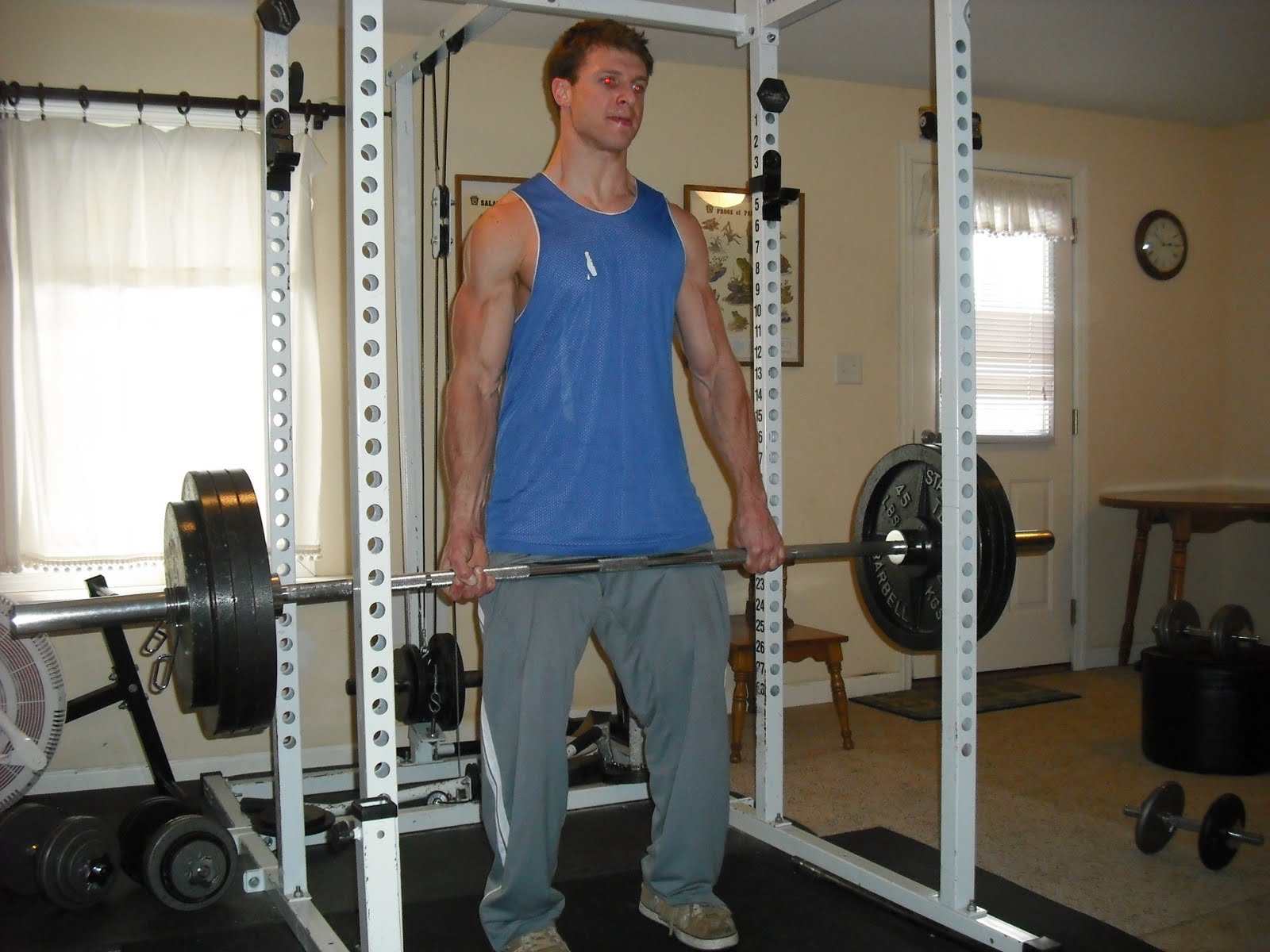
385, 5 X 8

4.08.2010

Spare the Arm IV: Stretching/Warm Up

- - - - - -
Spare the Arm I: Intro and the odds aren't good.
Spare the Arm II: Pitching Mechanics
Spare the Arm III: Strength and Power Training
- - - - - -

Stretching Like Bread

Before I was born, bread was okay, by default. Then it was absolutely good for you as a staple of life. Then suddenly it was a horrible hazard, with all those miserable carbs. Then some types of bread were better than others and even good in certain amounts.

Now I stand in the grocery store paralyzed by too many options, waiting for morning news shows to tell me what I'm buying today. Bread is unhealthy for my time management.

Likewise, there was a time when few athletes gave flexibility much attention. Then they were told that stretching is essential in terms of injury prevention and increased performance (1). Then they discovered that stretching has no effect on injury rates and actually decreases performance in certain activities (5).
Since pitching is a power sport, pitchers should avoid stretching?

Wrong.

So then the typical jogging and stretching that pitchers do before practices and games is okay?

Well, that's not so great either.

We talk about stretching and flexibility like they are one thing that we've owned. Not so. Static and dynamic flexibility are both important, but not the same. We need to be specific. What kind of stretching to accomplish what purpose? Here's an attempt to keep you from being paralyzed by stretching, like me at the grocery store.


Admitting We Have A Problem

Most individuals have some degree of imbalance or tightness somewhere throughout the body. Years of being a desk jockey will do that to any person who doesn't make a considerable effort. Even if you manage to sit without becoming a hunchback and you have a fairly sound body structure, years of pitching will definitely create asymmetry.

Pitching places extreme demands on the body, and we can't afford to neglect the structural imbalance that pitching creates. Sure, there are issue with the throwing arm, loss of shoulder internal rotation being the most drastic and common (3, 4). But what about the congenital or acquired deficits elsewhere (especially the scapula, thoracic spine, and hips)?

Pitchers should be as concerned with sitting as they are with their rotor cup exercises and amino acid supplements. Do you sit in class or commute any distance? Do you watch movies or play video games? Are you reading this with the same crappy posture with which I'm typing?


Chronic prolonged sitting is the bad guy for a lot of people, and pitchers are no exception. Here are just a few ways that couch-chair syndrome causes adaptive changes all over the body:

-Cervical spine protrusion (forward head posture)
-Loss of thoracic spine and lumbar spine extension and rotation
-Shortened pectoralis major and minor, lats, and subscapularis (scapula protraction)
-Loss of hip extension and internal rotation

All of these can lead to a number of flexibility and stability problems, which absolutely promote strain to the arm during pitching. On the other hand, here are a few of the typical imbalances that pitching actually creates:
-Loss of internal rotation on the lead hip
-Loss of hip extension on the lead hip
-Loss of hip flexion on the back (push off) hip
-Pectoral and triceps tightness
-Protraction of the scapula
-Loss of shoulder internal rotation (throwing arm)
-Loss of elbow extension (throwing arm)


So what are you going to do about it?

Static Stretching

Static stretching and joint mobilization are essential for improving specific limitations like those listed above. Static stretches are not the best use of time right before games, but they are great for remodeling; creating actual changes in muscle length and joint function (5, 6).

It's no wonder that research has shown static stretching to have no immediate benefit to sports performance. A recent study that examined the effects of static stretching on pitching performance cites 23 other experiments that have shown it to either significantly decrease or not change various measures of strength and power (8).

Decreased performance in explosive strength/power activities have often been attributed to increased compliance of the muscle tendon unit as well as changes in the nervous system. It's like over extending a rubber band, making it more slack and less responsive and less sensitive to normal movements.

Good for camaraderie before the game, but that's about it.
The above noted study showed that static stretching of the shoulder had no significant adverse (or beneficial) effects on throwing velocity or accuracy. This is likely because throwing is a complex skill that involves a number of joints and muscle groups, and the stretches were only applied to the shoulder (8, 9).
Is it any surprise that a general static stretching program applied to athletes who have not been assessed for their specific flexibility deficits or imbalance has no significant effect on injury prevention (10, 11)? With that kind of study, the athletes end up stretching fairly normal tissue and unconsciously moving around tightness they do have.

The results would possibly be much different in a study that applied specific corrective exercises based on an assessment of individual structure and function.

For example, a coach or parent may note that a pitcher with elbow pain is "flying open" too early in the delivery. The player is frustrated when he struggles to correct his form like they want him to. When he is finally able to stay "closed" longer, the extensive adjustments needed to make that happen cause a large decrease in velocity and accuracy.

This is the "lessons" we're trying to avoid at GoWags.

Why is he opening up to soon? Is the thoracic spine tight? Is the scapula or lumbar spine unstable? Is the back hip lacking extension or internal rotation? The elbow problem may be coming all the way from the foot or ankle. A tight ankle can cause mistiming of torso rotation due to less loading and explosive triple extension off the back leg.
Any and all of these things can cause the "early opening" that promotes pain and suboptimal performance.

Pitchers should give attention to their hips in all planes of motion beyond their hamstrings; internal and external rotation, extension, and abduction. Scapular retraction and thoracic mobility work for extension and rotation is mandatory. If nothing else, pitchers need to frequently perform the internal rotation "sleeper" stretches and cross body shoulder mobilizations (with correct form) to counter the forces that cause posterior capsular tightness and actual twisting of the humerus.

As for the how to static stretch, three or four repetitions of twenty or thirty second is plenty (12). Do them s l o w l y after games and during or after workouts. Pay attention to correct alignment and immobilization of other joints, as I almost always see athletes unconsciously position the body in a way that follows the path of least resistance around tight areas.

So yes, pitchers should devote time to their flexibility. Ideally, they should undergo a head to toe assessment to identify and correct any specific impairments. Static stretching is a critical component of doing that, but it's unlikely to help (or hurt) performance on the spot.

Dynamic Stretching

Dynamic stretching refers to calisthenic type movements. Jogging with high knees, lunge walks, and "butt kicks" are pretty typical in most sports. While dynamic stretches do not "lock in" specific positions to create specific alterations in joint motion, they are the best way to break a sweat before competition. They get the athlete moving with the entire body engaged.
Backward lunge with overhead reach
Pitchers may do mulitdirectional lunges with various upper body rotations and reaches to provide a non extreme stretch of multiple body segments. Inferior and posterior (shoulder) capsule stretches are even better when they're incorporated with lunges. The "fence hurdle/under" drill is excellent for hip and spine mobility.

The typical pre-game and practice routine is to jog a little then hang out over static stretches, many of them performed while sitting. So in effect, after athletes have sat all day at work, school, or traveling, they sit and relax, introducing slack before demanding repeat explosions of the musculoskeletal system.

Warming Up

Most athletes know that raising body temperature and increasing circulation to the the muscles and joints is the point of a good warm up. But don't forget that the nervous system is boss. You can raise body temperature and circulation any number of ways, but pitchers should do so in a manner that also primes the nervous system for explosive bursts of short duration activity.

You can jog around the field and still be half asleep, out in left field. But you must focus to successfully perform high speed arm and leg agility drills. Beyond the lunge variations and dynamic stretches mentioned above, pitchers can include some low repetition leaps, bounds, and high speed tubing work. Some coaches have advocated more creative warm ups like punching and kicking a heavy bag for short intervals.

And Now You're Ready

Pitchers should apply specific static stretches to their ankles, hips, trunk, and yes, shoulders too. Whole body dynamic flexibility movements and agility/quickness drills are best for breaking a sweat and priming the nervous system to mow batters. All these, with an appropriate strength/power training program as outlined in Part III, are needed to create and sustain optimal performance of the throwing arm.

For the record, I load up on BJs whole wheat bread. It's good for power, or something like that.

- - - - -

1. Pollock ML, Gaesser GA, Butcher JD, Despres J, Dishman RK, Franklin BA, and Garber CE. The recommended quantity and quality of exercise for development of cardiorespiratory and muscular fitness, and flexibility in healthy adults. Med Sci Sports Exerc 30:975-91, 1998.

2. Kibler WB and Livingston B. Closed chain rehabilitation for the upper and lower extremities. J Am Acad Orthop Surg 9:412-21, 2001.

3. Tokish JM, Curtin MS, Kim YK, Hawkins RJ, and Torry MR. Glenohumeral internal rotation deficit in the asymptomatic professional pitcher and it's relationship to humeral retroversion.

4. Osbahr DC, Cannon DL, and Speer KP. Retroversion of the humerus n the throwing shoulder of college baseball pitchers. Am J Sports Med 30, 347-353; 2002.

5. Wilkinson A. ‘Stretching the truth: a review of the literature.’ The Australian Journal of Physiotherapy 38(4)283-7: 1992.

6. Zachazewski JE (1990) ‘Flexibility for Sports’ in B Sanders (Ed), Sports Physical Therapy (pp 201- 238). Norwalk, Conn: Appleton & Lange

7. Taylor DC et al (1990) ‘Viscoelastic properties of muscle-tendon units. The biomechanical effects of stretching.’ The American Journal of Sports Medicine. 18(3): 300-309

8. Haag SJ, Wright GA, Gillette CM, and Greany JF. Effects of acute static stretching of the throwing shoulder on pitching performance of NCAA DIII baseball players. J Strength Cond Res 24(2):452-7, 2010.

9. Burkhart SS, Morgan CD, Kibler WB. Shoulder injuries in overhead athletes: the
dead arm revisited. Clin Sports Med 2000;19:125–59.

10. Anderson K, Strickland SM, and Warren R. Hip and groin injuries in athletes. Am J Sports Med 2001; 29:521-23.

11. Orchard, JW. Instrinsic and extrinsic risk factors for muscle strains in Australian football. Am J Sports Med. 2001;29:300-03.

12. Mallac C. A physiotherapist's view on flexibility in Brian Mackenzie's Successful Coaching. 2004(8):1745-53.